
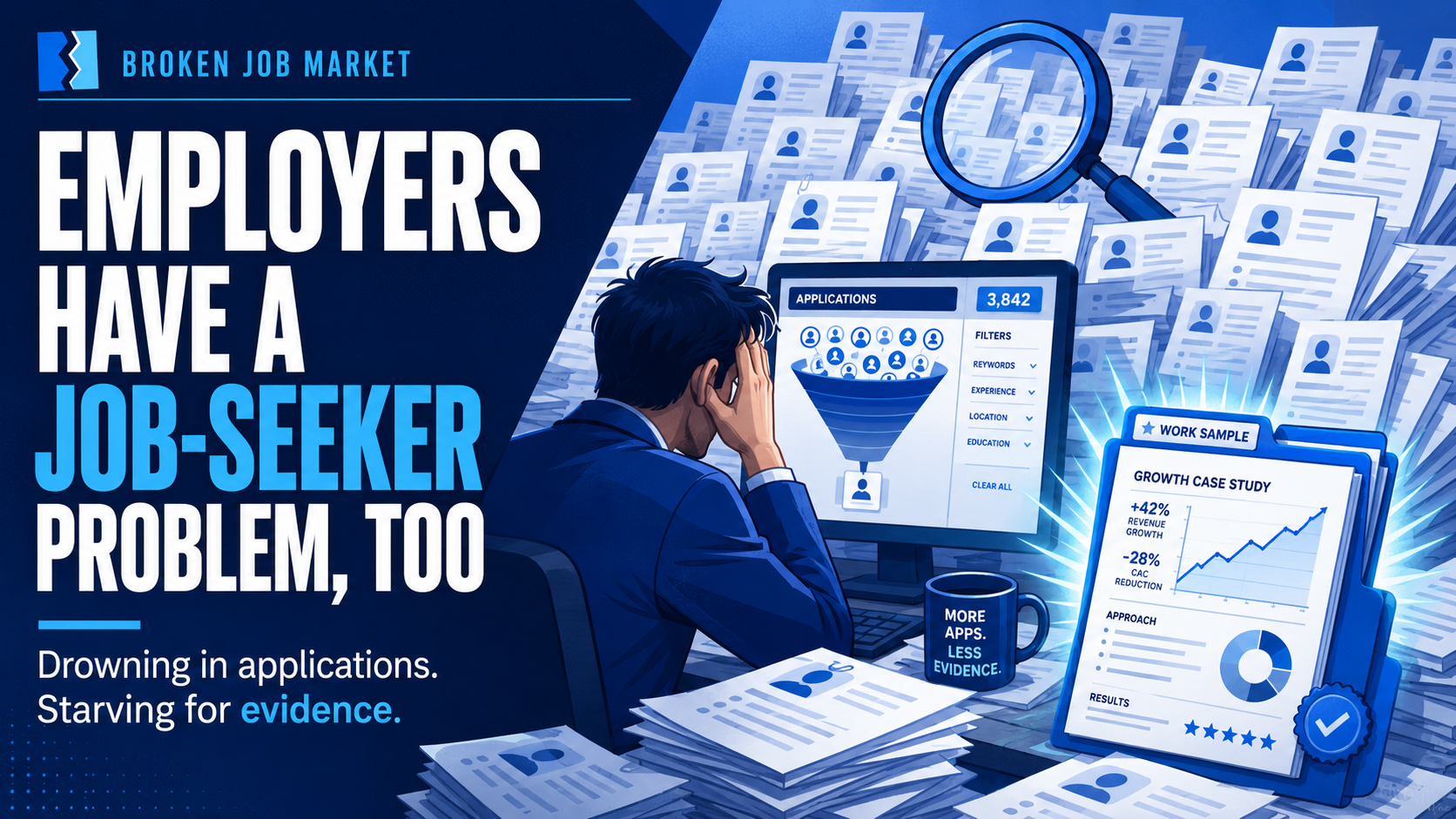
There is something wonderfully absurd about the job market right now. Job seekers say nobody will talk to them. Employers say they cannot find anybody worth hiring. Between the two sits an enormous electronic pile of resumes.
LinkedIn recently reported that the number of applicants per U.S. job opening has doubled since the spring of 2022, even as two-thirds of recruiters say finding qualified candidates has become harder. More candidates, yet more difficulty finding one. That is not how this is supposed to work. If you put twice as many fish in the pond, fishing ought to get easier - unless, of course, somebody has dumped so much stuff into the water that nobody can see the fish anymore.
That may be a reasonable description of hiring in 2026.
It has never been easier to apply for a job. Find an opening, feed the description into an AI tool, adjust the resume, produce a cover letter, hit send and move on. Twenty applications before lunch is no longer especially difficult.
Employers, naturally enough, responded with machinery of their own. Applicant-tracking systems became more sophisticated, screening became more automated, and recruiters began using AI to find plausible candidates buried inside the applicant pile. We have now arrived at something close to the inevitable conclusion: machines producing applications for machines that screen applications, while somewhere inside the machinery are presumably two human beings who might actually enjoy working together.
The practical problem for employers is no longer simply finding people who look qualified. Technology has become remarkably good at making people look qualified.
Almost every resume is polished now. Candidates are strategic, collaborative and relentlessly focused on impact. After reading enough of them, you begin to wonder whether anyone in America has ever simply gone to work and done a decent job.
That does not mean job seekers should stop using AI. That would be silly, and employers certainly are not stopping. But it does mean that polish is losing some of its value.
A strong resume once told an employer something about the applicant. A well-written cover letter suggested, at minimum, that the person could write a good letter. Today, immaculate prose may simply demonstrate that the applicant has discovered the same tools everyone else has.
The words are getting cheaper, while evidence is becoming more valuable. That, I think, is where the opportunity lies for job seekers.
Suppose I am hiring someone and 300 applications arrive. I can eliminate a good number quickly because the experience is wrong, the location does not work, the salary expectations are impossible or something else simply does not fit. But sooner or later I may still be looking at 40 or 50 people who seem perfectly plausible. They all have good resumes. Most have the right keywords. A surprising number have apparently spent their careers "spearheading transformative initiatives."
Now what?
This is where the candidate who provides something concrete begins to look different - not louder or more clever, simply more believable.
A salesperson can say that revenue increased 31 percent after she took over the territory. An operations manager can explain that customer complaints were taking four days to resolve, that he changed the process, and that within six months the average was down to one. A marketing candidate can show the campaign. A writer can show the work.
The point is not that everyone needs a portfolio. It is that there is a fundamental difference between saying, "I am good at this," and saying, "Here is what happened when I did it."
In Get Hired in a Broken Job Market, we call this Proof-First Hiring. The phrase may sound grander than the idea, which is really very ordinary: if you make a claim, bring a receipt.
Employers appear to be moving in much the same direction. Skills-based hiring continues to grow, along with structured interviews, assessments and other attempts to see what candidates can actually do rather than relying entirely on credentials and polished application materials.
Candidates sometimes hate these tests, occasionally with good reason. There is a considerable difference between asking someone to demonstrate a skill and asking for three days of free consulting work. But the underlying impulse makes sense. If I am hiring a writer, eventually I want to see whether the person can write. If someone claims to be an Excel wizard, at some point it seems reasonable to put Excel on the screen.
For strong candidates, this may actually be good news. The more hiring moves away from "Who wrote the prettiest resume?" and toward "Who can do the work?" the more opportunity there is to separate yourself from people who have merely learned how to look good on an application.
There is another reason employers are becoming more suspicious. They are no longer dealing only with exaggerated resumes. Some are confronting fake applicants, questionable identities and candidates using AI during interviews in ways that make it difficult to know who - or what - is actually answering the question.
The technology is still evolving, but the direction seems clear enough: authenticity itself is becoming a hiring credential.
That does not mean proving your humanity by writing badly. Nor does it mean refusing to use AI. By all means use it to prepare for an interview. Have it challenge your answers, suggest questions you are likely to get and point out holes in your resume.
But eventually, turn it off.
You ought to be able to explain your own career without consulting a machine. If your resume says you transformed a department, somebody may ask what the department looked like before you transformed it. If sales increased 42 percent, somebody may reasonably want to know how. If you claim expertise in an obscure field, do not be surprised when the interviewer knows something about the obscure field too.
This is one reason I think job seekers may also need to reconsider the obsession with application volume.
I understand where it comes from. A person sends out 30 applications and gets almost no response, so the natural conclusion is that 30 was not enough. Then the number becomes 100, then 200, until the job search begins to resemble direct-mail advertising: send enough pieces and something has to happen.
Maybe.
But there is another possibility. The person who applies to 25 jobs with serious preparation may have an advantage over the person who applies to 250 with superficial preparation.
Serious preparation does not mean memorizing the company mission statement so you can repeat it back during an interview. It means understanding enough about the business to have some idea why the company may be hiring this person now and what problem may be sitting on the hiring manager's desk.
That is where experience becomes useful instead of merely historical.
"I have eight years of marketing experience" is information.
"We had exactly this problem at my last company, and here is what we tried" is the beginning of a conversation.
The same is true of human connection.
People talk endlessly about networking, which is unfortunate because the word itself has become almost unbearable. It conjures up name tags, conference rooms and strangers asking each other what they do. What actually matters is much simpler: somebody knows who you are.
A resume says you think you are good. A former colleague who tells a hiring manager, "You should talk to this person," adds something technology still has trouble manufacturing convincingly: trust.
And trust is becoming scarce.
Even ordinary professionalism can distinguish somebody now. Employers complain about candidates disappearing during the hiring process, and candidates quite reasonably point out that employers have been disappearing on them for years. Both are true, but neither makes ghosting particularly smart.
If you have taken another position, say so. If you are no longer interested, withdraw. If you agreed to show up at two o'clock, show up at two o'clock. Careers are long, industries are smaller than they look, and reputations have a funny way of moving around.
None of this lets employers off the hook. They helped build the system they now complain about.
Companies made applying almost frictionless and were surprised when people began applying indiscriminately. They added automated screening systems, so candidates learned to write for the screening systems. They produced job descriptions that seemed to include every qualification ever possessed by anyone in the department, stretched interviews into marathons and often left applicants waiting for weeks. Some advertised jobs they were not particularly committed to filling.
Now employers complain about applicants while applicants complain about employers, and everybody has evidence.
For the job seeker, however, the important question is not who deserves more blame. It is what works.
I increasingly think the answer is going to involve doing less of what everybody else is doing - not fewer applications for the virtue of sending fewer applications, but better ones. Applications that show some understanding of the employer, contain real accomplishments rather than inventories of responsibility, and give the reader some reason to believe that the person on the page has actually done the work being described.
That evidence might be a work sample, a short case study, an introduction from someone credible or simply the ability to talk concretely about what happened, what went wrong, what changed and what you personally contributed.
You cannot control the entire hiring system. You cannot control the number of applicants, a sudden hiring freeze, an internal candidate or whatever the algorithm decides to do with your resume.
But you can decide not to become more noise.
Employers have plenty of applications. What they do not necessarily have is enough confidence in the people behind them.
So give them something more useful than another set of perfectly polished adjectives.
Give them a reason to believe you.