
If you are using AI to write your résumé and cover letter these days, you are hardly alone.
It is fast. It is inexpensive. It knows what a professional résumé is supposed to sound like. Give it a job description and a decent account of your experience and it can produce something polished, orderly and impressively matched to the opportunity before you have finished your coffee.
There is only one problem.
A few million other people have discovered the same thing.
And employers are beginning to notice.
Recruiters are now dealing with applications that can be remarkably polished and remarkably similar. AI-assisted résumé screening is already common, and some recruiters are also experimenting with third-party AI-detection tools. But there is an important distinction: the major applicant-tracking systems generally are not designed to declare that AI wrote your résumé. The more immediate problem is that recruiters are learning to recognize the result — generic language, suspiciously smooth prose and candidates who somehow all sound as though they graduated from the same corporate finishing school.
In other words, AI may have helped you improve your résumé right up to the point where it flat-ironed the humanity out of it.
No sharp edges. No odd turns. No distinctive voice. No sense that a particular person with a particular history made the decisions described on the page.
Just another strategically minded professional who has successfully leveraged something.
This is becoming a genuine problem for employers. Recruiters confronted with increasingly polished but difficult-to-distinguish applications are putting more weight on referrals, live conversations, demonstrated skills and other evidence that there is an actual person behind the application.
Machines arguing with machines
Which brings us to one of the stranger developments in modern employment.
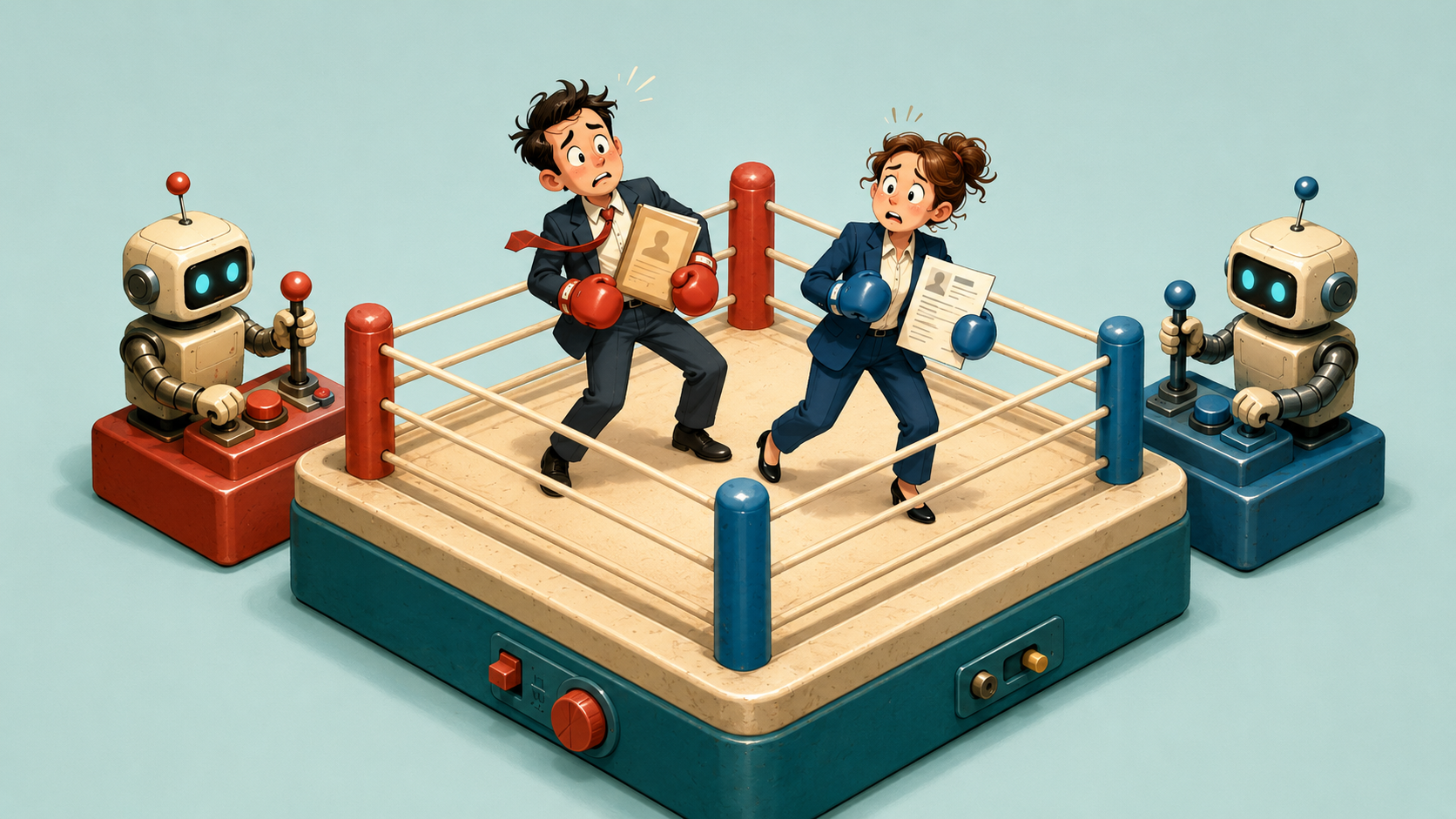
The employer may be using AI to help write the job description. You may be using AI to write the résumé responding to it. The employer may then use AI to screen your résumé, perhaps alongside tools or human judgment intended to identify material that looks suspiciously AI-generated.
You, having learned this, will naturally go back to AI and ask it to make your AI-written résumé sound less AI-written.
This is no longer exactly a hiring process.
It is machines arguing with machines about the authenticity of humans neither has met.
And we are only getting started.
The next obvious product will be software designed specifically to restore artificial humanity to machine-generated prose.
Click the "Humanize" button and it will rough up the sentences a little. Push the setting higher and perhaps it will insert an awkward phrase or questionable comma.
At the premium level, the system may offer several authenticity settings, ranging from "seasoned executive" to "competent person who wrote this at 11:47 p.m. after a long day."
Push the slider all the way to 100 percent human and it will misspell the recruiter's name and forget to attach the résumé.
Authenticity confirmed.
Employers helped build this
It is tempting to blame applicants for creating this situation, but employers helped build it.
Companies became overwhelmed with applications and turned to technology to sort them. Candidates realized that machines were increasingly standing between them and a human reader, so they began optimizing their résumés for the machines. Then AI made it possible to produce more tailored applications much more quickly, increasing the volume employers had to process.
More applications produced more automation. More automation produced more optimization.
The machinery expanded. The people became harder to locate.
Somewhere underneath all of this, a hiring manager simply wanted to hire a regional sales director.
The AGI question in the background
What makes the situation more interesting is that Silicon Valley is simultaneously having a much larger conversation about artificial general intelligence.
The terminology is debatable, and it may remain debatable for quite some time. But the direction is not. AI systems are becoming better at reasoning, using tools and carrying out complicated tasks with less human intervention. We are moving from the model that answers a question toward the agent that can be given an objective and told to go do something about it.
That changes the employment question considerably.
Before AI actually replaces large numbers of workers — if it ever does — it may increasingly occupy the territory surrounding the worker.
Today an AI system helps write the résumé. Soon an agent can find the opening, research the employer, decide whether the opportunity makes sense and prepare much of the application.
On the other side, another agent may help define the position, search for candidates and decide which applicants deserve attention.
Eventually your agent may apply to their agent.
Perhaps the agents can have coffee.
The humans could stay home.
What did you actually accomplish?
Today we are asking whether AI wrote the résumé.
Tomorrow we may have to ask whether AI did the accomplishment described on the résumé.
Suppose a marketing executive says she developed a campaign that increased sales 18 percent.
Except an AI system performed much of the research, generated several approaches, tested them and analyzed the results.
What exactly did the executive do?
Possibly quite a lot. Perhaps she recognized the real problem. Perhaps she rejected the obvious recommendation. Perhaps she understood something about the customer that the data did not. Perhaps she exercised judgment at the moment when judgment mattered.
Management has always involved accomplishing things through other people. Nobody expects the CEO personally to write the software and load the delivery truck.
But AI introduces a peculiar new participant into the organization: something that may perform meaningful portions of the work without actually becoming part of the workforce.
That means the traditional résumé question — What did you accomplish? — may eventually need a companion.
What part of that accomplishment was actually yours?
That may turn out to be one of the more interesting employment questions of the emerging AI era.
The answer is not to stop using AI
Take the idea a little further and the corporate future becomes almost comical.
AI creates the job. AI selects the candidates. AI conducts the preliminary interview. The successful employee arrives and spends much of the day directing AI agents that perform substantial portions of the work.
Eventually another system evaluates her performance. She uses AI to prepare her response.
Then one morning she receives an exquisitely composed email explaining that her position has been eliminated because of productivity improvements made possible by artificial intelligence.
The CEO announces the restructuring using remarks written by AI.
Wall Street applauds.
At which point somebody in accounting may raise a perfectly reasonable question about why the company still employs people.
That is the grand economic question surrounding AGI, and society is nowhere near answering it.
But there is a much smaller question that job seekers have to answer right now.
How do you use this technology without allowing it to erase you?
For decades, applicants were taught to polish themselves relentlessly. Remove the peculiarities. Use professional language. Say things the approved way. Produce the immaculate résumé.
That advice made sense when immaculate professional writing was difficult to produce.
It isn't anymore.
When polish becomes nearly free, polish loses some of its power to distinguish you.
The scarce commodity becomes something different.
Maybe it is a sentence that could only have come from someone who actually did the work. Maybe it is an accomplishment strange enough to require explanation. Maybe it is simply a point of view.
Not forced eccentricity. Not bad grammar. Not some carefully manufactured "personal brand."
Just evidence that an actual person inhabited the career being described.
This is why the answer is not to stop using AI.
Use it.
Let it challenge your résumé. Let it help you find buried accomplishments. Let it show you where the language is weak or the connection to a particular job is unclear.
But don't automatically accept the polished creature it hands back.
Read it.
Ask yourself whether you would actually say those things. Ask whether somebody who knows you would recognize the person on the page.
Because there is a point at which improvement becomes sterilization.
You put twenty complicated years of work into the machine — the strange assignments, mistakes, recoveries, good decisions and improbable successes — and out comes a gleaming description of someone who spent two decades "leveraging strategic initiatives to drive transformational outcomes."
Nobody wants to meet that person.
Mostly because that person has never existed.
So perhaps the best defense against the increasingly automated hiring system is not to reject AI at all.
It is to use AI without surrendering authorship of yourself.
Leave some fingerprints.
Keep a few sharp edges.
Because we are moving toward a peculiar moment in employment.
Employers will increasingly use AI to create jobs and screen applicants. Candidates will increasingly use AI to pursue those jobs. Both sides will devise new technologies to figure out what the other side's technology has done.
And somewhere inside this astonishingly sophisticated argument among machines, two human beings will still have to decide whether they want to work together.
We might want to make sure they can still recognize each other.
Sources:
- Jobscan — "Can ATS Detect AI Resumes in 2026? Here's the Real Answer," May 12, 2026
- Forbes — "AI Resumes Are Pushing Recruiters Back To Referrals And Live Tests," Aug. 25, 2026
- WIRED — "AI Use in the Job Market Is Creating an Infinite Doom Loop," Sept. 4, 2026
- WIRED — "The Logical End Point of AI Job Interviews Is Two Bots Talking to Each Other," Sept. 2, 2026