
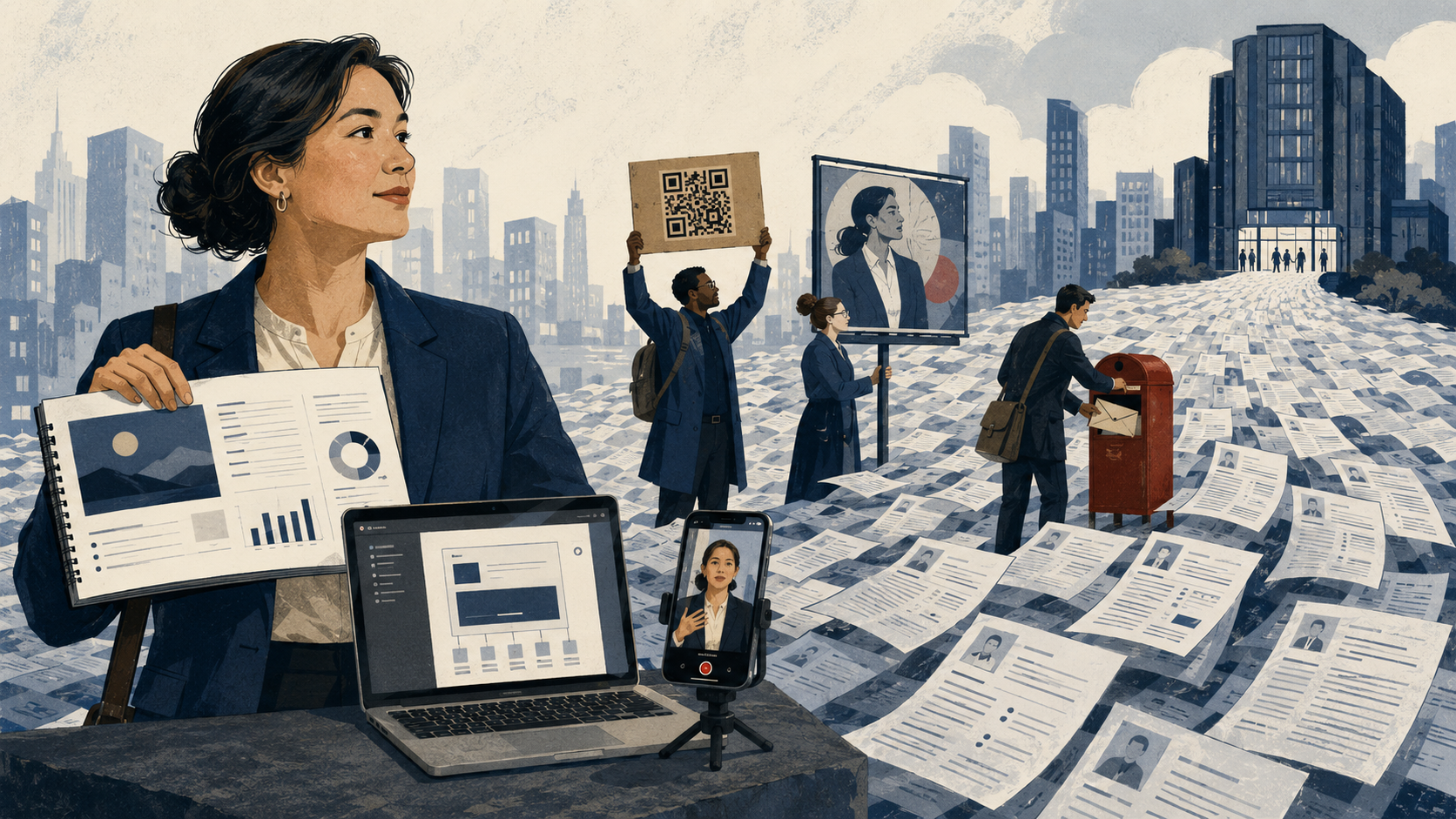
In a functioning hiring market, you submit a résumé, somebody reads it and the best-qualified candidates receive interviews.
That quaint little arrangement is breaking down.
Employers are buried under hundreds or even thousands of applications, many of them polished by the same AI tools and stuffed with the same language. Job seekers, meanwhile, can submit 200 applications without receiving so much as a human rejection.
People are responding by becoming their own advertising agencies. They are producing videos, mailing packages, building prototypes, approaching CEOs and, in a few cases, standing on street corners with their qualifications printed on a sign.
The results range from inspired to ridiculous. The useful question is whether the tactic demonstrates anything beyond a willingness to make a spectacle of yourself.
The 94-Second Résumé
After submitting 300 applications, Dartmouth student Anya Roodnitsky abandoned the usual script. She created a funny 94-second Instagram video explaining why somebody should hire her.
The presentation was deliberately informal. She described her work as a teaching assistant as "elite babysitting" and joked about her academic experience. It sounded like a person speaking rather than another applicant reading from the Book of Approved Corporate Phrases.
The video attracted more than 500,000 views, generated interviews and helped her land a job with a solar-energy company. Her experience is part of a broader movement among younger applicants who are using Instagram and TikTok as alternatives to the increasingly congested LinkedIn application process.
Video works particularly well for positions involving sales, communications, marketing, training or customer contact. It gives an employer a glimpse of the person behind the résumé.
It can also go badly. A five-minute monologue recorded in a bedroom is unlikely to rescue a weak candidacy. The successful videos are brief, specific and appropriate to the kind of work the applicant hopes to perform.
The Cover Letter Becomes a Pitch Deck
Other candidates are replacing the cover letter with a small presentation created specifically for the employer.
Julissa Machado wanted to move from recruiting into sales development, despite having no direct experience in that field. She prepared individualized slide decks using each prospective employer's colors, typefaces and logos. The presentations connected her experience to the position, included measurable accomplishments and explained why she was interested in that particular company.
The process took considerably more time than sending a standard cover letter. She found a job with a software company within 30 days.
A similar pattern appeared when Jennifer Dulski, CEO of Rising Team, received more than 800 applications for a chief-of-staff position. Three applicants broke away from the pack. One submitted a slide deck, another included a video presentation and a third prepared a "user manual" using terminology found in the company's own materials.
All three received interviews.
Dulski said the additional research and creative effort made the applicants stand out. The person eventually hired had never previously served as a chief of staff.
The format certainly helped. The substance mattered more. These candidates had studied the company closely enough to produce something that could not have been sent to 50 other employers.
That alone separated them from most of the field.
Performing Part of the Job Before You Have It
The strongest unconventional applications contain a sample of the work.
A marketing applicant might analyze a company's current campaign and propose an alternative. A salesperson could identify several promising accounts and explain how they would approach them. A programmer might build a small feature. A communications candidate could prepare a draft announcement or a short media plan.
This is proof-first hiring: give the employer a small, credible demonstration instead of another collection of claims.
The sample does not have to be large. In fact, it probably should not be. Nobody wants to receive a 47-page strategic plan from a stranger who has never worked inside the organization.
A useful sample might consist of three observations, two recommendations and one example of how the candidate would proceed. It should acknowledge the obvious limitation: the applicant does not possess the company's internal information.
The objective is to demonstrate curiosity, judgment and an ability to turn information into useful work.
This approach also avoids the indignity of handing over a complete project that the company might use without hiring or paying you. A sample should reveal how you think without donating several weeks of free labor.
Going Directly to the Boss
Some candidates are bypassing the application machinery altogether.
Marketing professional Cathy Xie had been mass-applying for positions without success. When she saw that the founder of a housing startup was hiring a marketing manager, she sent him a 150-word email with the subject line, "My landlord inspired this email."
The message connected her experience and interest directly to the company's mission. The founder responded, interviews followed and she received the job.
This was not simply a clever subject line. Xie had followed the founder's work, understood the company and wrote an email that sounded as though it came from a human being.
Direct outreach can be effective when it is informed and restrained. Sending the CEO six follow-up messages and then locating the executive's private telephone number crosses into entirely different territory.
Paper Makes a Modest Comeback
The flood of digital applications is also producing an unexpected revival of paper.
Tyler Sorenson had applied online repeatedly without success. He finally walked into a local technology-repair company and handed over a paper résumé. The district manager happened to be there. Sorenson received a call a week later and was asked to submit the formal application that eventually led to the job.
Some employers say they appreciate walk-in applicants because appearing in person provides an immediate indication of effort, communication skills and basic professionalism. Paper résumés also stand apart from the AI-polished applications accumulating in electronic systems.
This tactic depends heavily on the industry. Walking into a hotel, restaurant, retail business, small manufacturer or local service company may be perfectly reasonable. Appearing unannounced at a pharmaceutical laboratory or corporate headquarters could result in an interesting conversation with security.
For professional positions, a short letter or useful work sample sent directly to the hiring manager may accomplish the same purpose without creating an awkward lobby scene.
Then There Are the Street Signs
The most visible tactics receive the most publicity.
After sending more than 1,000 applications, finance graduate Sam Rabinowitz walked outside the New York Stock Exchange carrying a sign that read, "Tried LinkedIn. Tried Email. Now Trying Wall Street."
The stunt attracted social-media attention and led to an impromptu meeting with a partner at an IPO firm. At the time the story was published, it had not produced a job offer.
In Charlotte, Chase Burton took a similar approach after submitting more than 300 applications. He stood near busy intersections holding a cardboard sign with a large QR code linking to his professional information.
These efforts require nerve. They also illustrate the difference between attracting attention and establishing value.
An executive may admire the candidate's determination. That admiration does not answer the employer's basic question: What can this person do for us?
Evidence Travels Farther Than Novelty
Unconventional tactics work best when the method fits the job.
A social-media campaign makes sense for a content creator. A prototype makes sense for a programmer or designer. A short account-development plan makes sense for a salesperson. A carefully researched letter makes sense for an executive.
The candidate is already providing evidence of the qualities the employer needs.
The billboard, costume, gift basket or street sign may make a person memorable for an afternoon. The pitch deck, prototype, analysis or work sample can start a serious business conversation.
Before attempting an unconventional move, ask two questions:
Does this demonstrate something an employer needs?
Would I still be proud of it if it failed to go viral?
If the answers are yes, you probably have a strategy.
If the entire idea depends on strangers staring at you, you probably have a stunt.
Sources: Business Insider (May 2026, August 2025, March 2026); Dartmouth Alumni Magazine (2026); The Guardian (May 28, 2026); WCNC Charlotte (July 17, 2026); New York Post (September 13, 2025).