
It Feels Broken Because It Is
The hiring system continues to function. Applications are submitted, resumes are screened, interviews are held, and people occasionally get hired. That does not make it healthy.
Over time, the system has been rebuilt around efficiency, risk reduction, and the convenience of employers. Helping a reasonable number of people find reasonable work in a reasonable amount of time appears to have fallen somewhere near the bottom of the list.
So when job seekers say the market feels broken, they are not imagining things. The system is working as currently configured. It simply was not configured with them in mind.
That is the truth beneath the cheerful earnings reports. The economy can be growing while your job search resembles a slow-motion car accident. The two are no longer traveling together, and nobody bothered to announce the divorce.
Consider the numbers.
The economy grew at an annual rate of 1.5 percent in the second quarter, following 2.1 percent growth in the first. Corporate profits increased by more than $400 billion. In August, the S&P 500 reached another record high.[1][2]
Hiring tells a different story. Employers added an average of only 31,000 jobs a month during the twelve months preceding August. About 1.9 million Americans had been unemployed for at least 27 weeks, accounting for 27 percent of everyone officially unemployed.[3]
Both sets of numbers are accurate. Reconciling them is where people get into trouble.
For years, a healthy economy and a healthy job market were roughly the same animal. Economic growth led companies to hire. Unemployment fell, wages rose, politicians took credit, and everyone else got on with their lives.
That relationship has become more remote. Think of a marriage in which both people still live in the house but haven't spoken since March.
Companies have learned how to grow without hiring.
The Economy Is Doing Great For Capital
Strong corporate profits no longer require a growing payroll. Wall Street often rewards companies for keeping payroll under control.
A company that increases revenue while holding down headcount looks terrific on an earnings call. The CFO gets a bonus. The board is delighted. Nobody on that call is thinking about the thirty-four-year-old marketing manager who lost her job in the latest restructuring and has since sent four hundred applications into a void that occasionally emails back.
GDP measures output. It tells us little about how many people were hired to produce that output, how many lost their jobs along the way, or whether the company eliminated twenty positions and described the resulting savings as "innovation."
Economic growth and employment growth can now move in very different directions. Job seekers are discovering that the hard way.
Hiring Has Become a Last Resort
Talk to recruiters who are still in the business — and quite a few have been automated out of their own jobs — and they will tell you that requisitions are down.
Weak business conditions account for some of that. Corporate reluctance accounts for plenty more. Before approving a hire, companies try nearly everything else.
They redistribute the work. They bring in contractors. They ask the existing staff to stretch a little further. Someone eventually buys an AI tool that promises to perform half the job for a fraction of the cost.
If all of that fails, an actual job posting may appear.
The government's own turnover data show how cautious employers have become. The national hiring rate was just 3.2 percent in July. Hiring in professional and business services fell by 188,000 during the month.[4] Economists often describe this as a "low-hire, low-fire" labor market. Layoffs have remained relatively contained, but employers show little enthusiasm for adding people.
Even when a posting appears, it may sit there for months. Funding may be uncertain. Approval may be delayed. The company may be collecting resumes for some future need. A ghost job can look perfectly legitimate while leading nowhere.
This resembles a slow-moving triage system more than the labor market we once knew. Job seekers are bleeding in the waiting room while the receptionist assures them the doctor will be right with them.
The Middle Is Taking the Hit
The strongest parts of the labor market tend to be at the edges.
People with scarce technical skills or considerable senior-level experience may still have leverage. Certain service positions remain difficult to fill. The government expects much of the coming decade's employment growth to be concentrated in health care and social assistance.[5]
The broad middle faces a harder time: managers, generalists, administrators, marketers, recruiters, project leaders, and other experienced people whose jobs can be consolidated, outsourced, delayed, or partly automated.
They may find themselves competing with hundreds of equally qualified applicants for a position the company feels no urgency to fill. Sometimes the company has not quite decided whether to fill it at all.
The stock market does not capture that experience. Neither does GDP. It is measured privately, at two in the morning, by people refreshing an inbox that isn't going to answer.
The Broken Market May Be Your Advantage
There is, oddly enough, an opportunity in all this.
Job seekers have responded to the difficult market by looking for technical tricks. They use AI to generate resumes, cover letters, and application answers, then deploy automated tools to submit them by the hundreds. A few have even planted hidden instructions in their resumes in hopes of manipulating the AI systems reviewing them.
Employers may be frustrating, indifferent, and occasionally ridiculous, but they are still the ones with jobs to offer. Your immediate competition comes from that flood of applicants trying to beat the system from the other side.
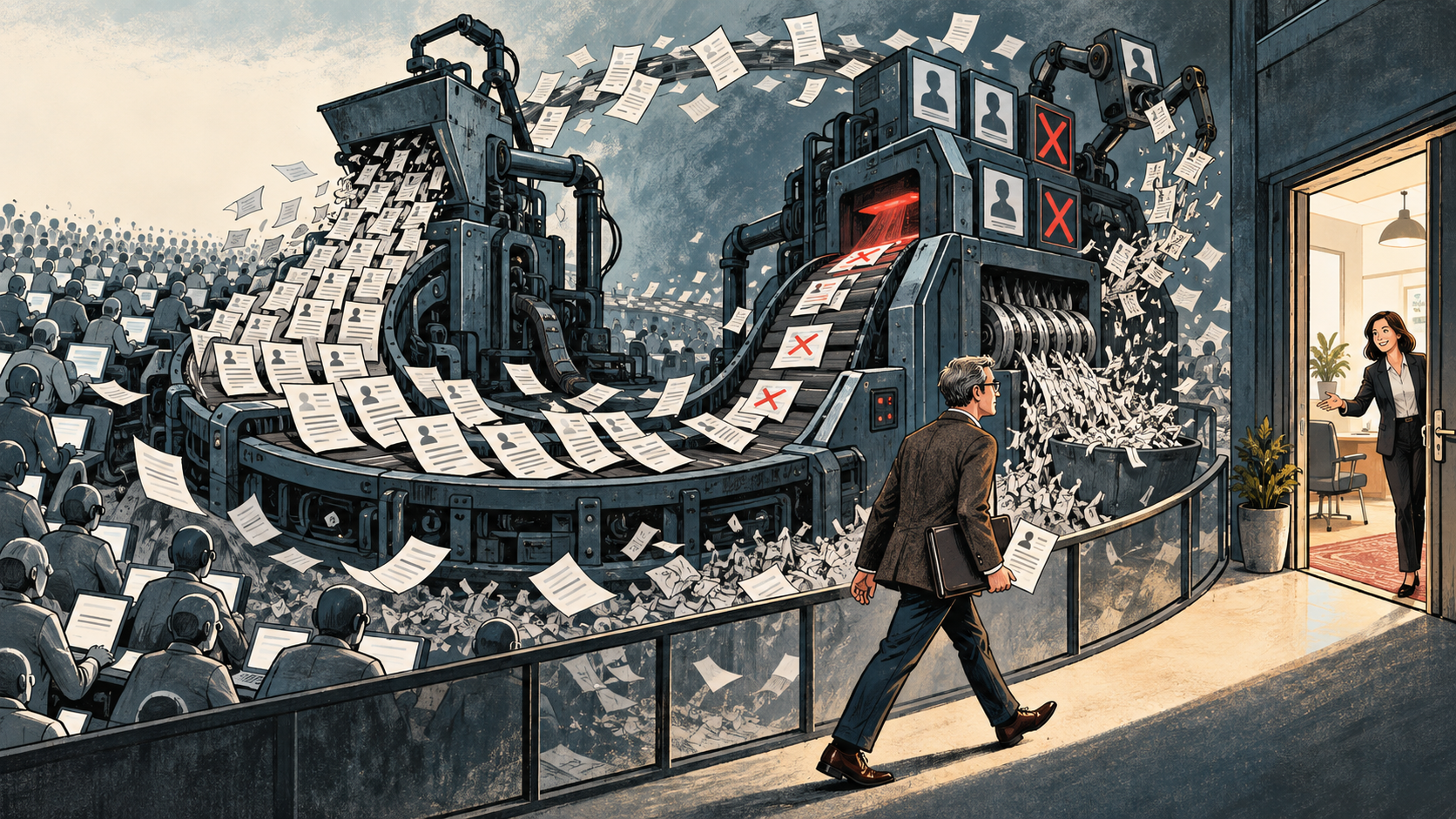
We now have an arms race. AI bots submit applications. Employer AI screens them. Candidates hunt for new ways around the filters, and employers add more filters. Volume rises, quality falls, and qualified people disappear in the traffic.
Nobody has gained much from this arrangement. Hiring has become more crowded, more suspicious, and more complicated. Employers add screening tests, software, interviews, and fresh opportunities to reject candidates before meeting them.
While everyone else is busy fighting the machinery, however, you have a chance to go around it.
Research the company. Find an actual person. Understand the business problem behind the opening. Show evidence that you can help solve it.
That approach once qualified as a good job search. Today, it is unusual enough to separate you from an enormous pile of interchangeable applications.
Standing out does not require a cleverer prompt or a faster application bot. It requires better targets, better research, direct contact, visible evidence, and the willingness to attempt things most applicants will never try.
Treat the search as a mission. Move carefully and strategically. Show up where the work actually lives. Most applicants will remain at home pressing the same button faster and wondering why nothing happens.
The job market is broken. Broken systems have gaps.
That is where the opportunities are.
Sources
- U.S. Bureau of Economic Analysis, GDP and Corporate Profits Second Quarter 2026, August 26, 2026.
- Reuters, S&P 500 Notches Record High Close, August 13, 2026.
- U.S. Bureau of Labor Statistics, The Employment Situation August 2026, September 4, 2026.
- U.S. Bureau of Labor Statistics, Job Openings and Labor Turnover July 2026, September 1, 2026.
- U.S. Bureau of Labor Statistics, Employment Projections 2025 to 2035, August 27, 2026.