
The Tuesday Letter — November 17, 2026
Dear Reader,
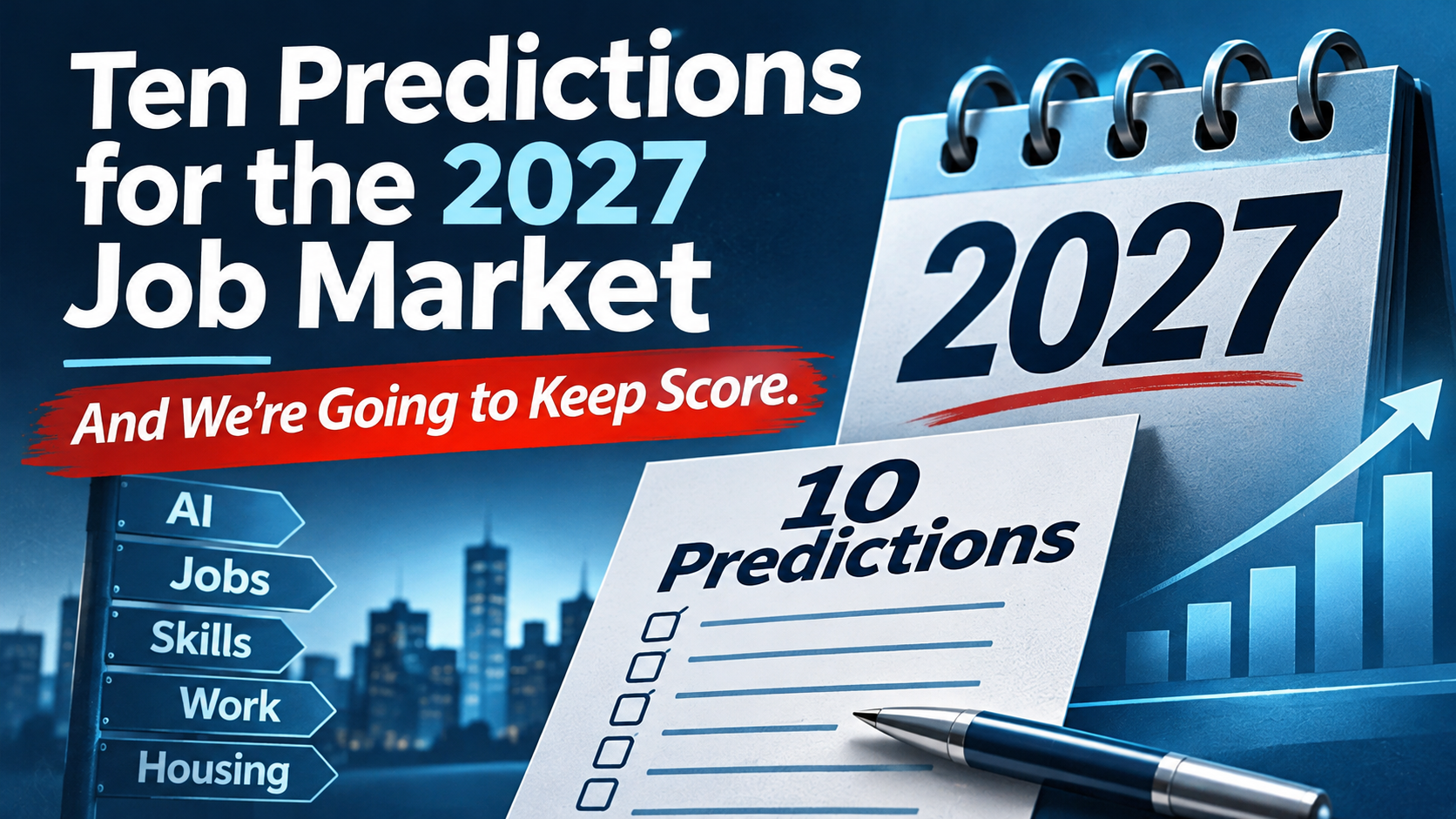
This week, I'm putting ten predictions about the 2027 job market on the record. We'll revisit them throughout the year, including the ones I may eventually wish I hadn't made.
My central concern is straightforward: companies may find ways to grow without hiring many more people. Business improves. Profits rise. The person who has spent seven months looking for work wonders when the good news will reach his inbox.
We're accustomed to thinking that a growing business eventually needs more employees. Artificial intelligence gives employers another option: increase the output of the people already there, combine responsibilities, and reconsider whether the next vacancy needs to be filled.
How extensively that happens will help determine what kind of job market we face in 2027.
The jobs that never open
Of the ten predictions, the one I feel most strongly about is that AI will eliminate more job openings than existing jobs.
Layoffs attract attention. A company dismisses several thousand employees, issues a statement about transformation, and assures everyone that it remains deeply committed to its people.
Reduced hiring is quieter.
Five employees leave. Three positions go unfilled. A department that expected to add four people gets permission to hire one. Work is redistributed, software takes over some assignments, and the remaining employees discover that "increased productivity" has arrived on their calendars.
No single decision looks especially dramatic. Across enough employers, however, those decisions could make finding work considerably harder.
That is a prediction, and measuring it will be difficult. We can count announced layoffs. Establishing how many people a company would have hired without AI requires evidence that a corporate earnings statement may not provide.
We'll need to be careful about attributing every hiring slowdown to technology. Economic uncertainty, business conditions, and ordinary cost cutting will still have plenty to answer for.
The pressure in the middle
Another prediction concerns experienced white-collar professionals — the marketing manager, financial analyst, recruiter, administrative supervisor, or communications specialist who has spent years becoming good at the job.
I expect more pressure on this group as employers experiment with combining roles and reducing management layers. Experience will remain valuable, but people may have to explain its value more explicitly.
What decisions can you make that someone less experienced would mishandle? What problems can you recognize before they become expensive? How can you use new tools while knowing when their answers are wrong?
Those questions deserve attention because much of an experienced employee's contribution can be difficult to see on a résumé. Judgment often looks uneventful. A problem was anticipated, a bad decision was avoided, and everyone went home without realizing how close the afternoon came to becoming a disaster.
Job seekers will need ways to make that contribution visible.
Which brings us to the résumé
One of the ten predictions is that employers will become increasingly skeptical of polished applications.
AI can help almost anyone produce a persuasive résumé. As that becomes ordinary, I expect employers to place more weight on work samples, practical exercises, and detailed conversations about what applicants have actually done.
Some of this could improve hiring. A person with an unconventional background may finally get to demonstrate an ability that a screening system overlooked.
Some of it could also produce another exhausting round of assignments before anyone discusses the salary.
For applicants, the useful response is to prepare a few concrete examples of their work. A short account of a problem you solved — what you noticed, what you did, and what happened — can support your résumé and give an interviewer something substantial to explore.
You shouldn't need to launch a personal media company to prove you can manage an office. You should be ready to explain how you made that office work better.
Ten predictions, with follow-up
The full article also considers entry-level employment, long-term unemployment, wages, contracting, practical AI skills, and the relative prospects for healthcare and skilled trades.
I don't expect a national employment collapse in 2027. I do expect considerable differences between occupations, industries, and individual experiences. A tolerable national unemployment rate could coexist with a punishing search for someone whose particular corner of the market has contracted.
These forecasts reflect my reading of employment research and my experience in recruiting, corporate management, and business ownership. They involve judgment, and some will be wrong.
We'll return to them throughout 2027, examine the evidence, and report where the predictions hold up, where they need qualification, and where they miss. A forecast ought to survive something more demanding than its publication date.
Read: Ten Predictions for the 2027 Job Market
Meanwhile, one useful step: choose an accomplishment from your work history and write half a page explaining it in plain language. Include your own contribution and an accurate result. Keep confidential information out of it.
That gives you something useful for your next interview or networking conversation — and something more distinctive than another declaration that you are a results-driven professional.
Charlie O'Neill BrokenJobMarket.com
The job market is broken. You are not.™