
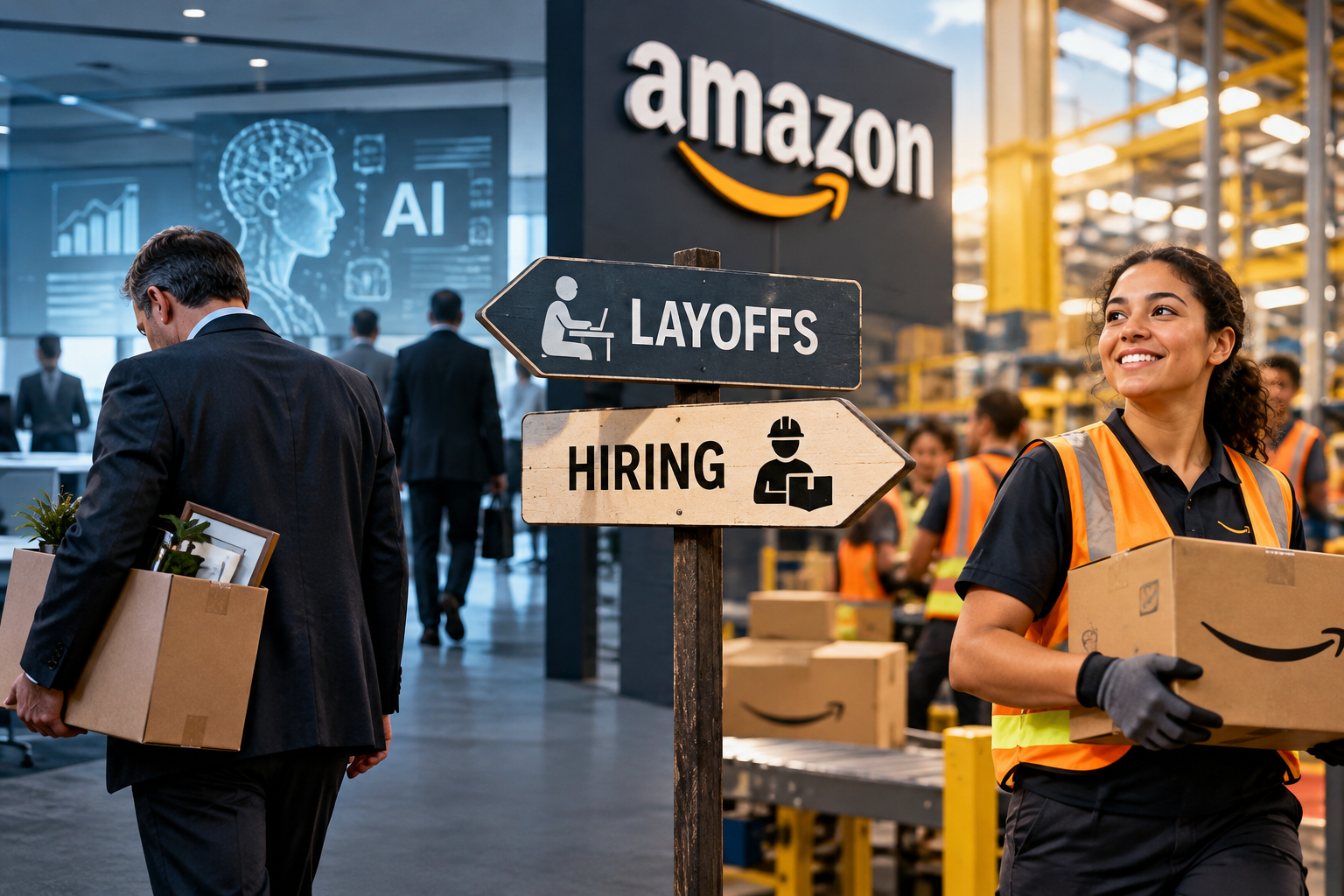
Amazon has apparently discovered an interesting new approach to employment. Get rid of 30,000 people. Then announce plans to hire 30,000 more.
Naturally, there's a catch.
The company that has been eliminating corporate positions while investing heavily in artificial intelligence is now promising 30,000 entry-level job opportunities in the United Kingdom by 2030.
The jobs aren't the same. They aren't even in the same country. And they certainly don't offer the same salaries or career prospects.
But that's what makes the story interesting.
For years, we were told that technology would eliminate relatively low-skilled jobs first. Warehouse workers, assembly-line employees, clerks, and anyone whose work involved repetitive tasks were supposedly first in line for replacement.
The college-educated professionals in their comfortable offices would be relatively safe.
Artificial intelligence has turned that assumption on its head.
AI can write software, analyze documents, prepare reports, and perform an expanding collection of tasks once assigned to well-paid professionals. Meanwhile, somebody still has to move packages, maintain equipment, and keep the physical machinery of commerce operating.
Yes, Amazon is investing heavily in warehouse robots, too. But replacing human workers isn't as simple as switching on another computer.
So we're watching one of the world's most technologically sophisticated companies reduce parts of its corporate workforce while continuing to recruit people for operational jobs.
And there's another interesting wrinkle.
Some of Amazon's new entry-level opportunities don't even require a résumé.
Think about that.
Across the professional employment market, candidates are being instructed to optimize their résumés for applicant tracking systems, master the right keywords, demonstrate AI proficiency, survive automated assessments, and sometimes endure interviews conducted by machines pretending to be people.
Meanwhile, Amazon is telling another category of applicants that they can show up without a résumé.
Perhaps there's a lesson here. When employers genuinely need people to perform particular jobs, they have an incentive to make hiring easier. When they have hundreds of applicants for every opening, the obstacles tend to multiply.
Of course, there's some fine print in Amazon's announcement. The 30,000 opportunities extend through 2030, include seasonal as well as permanent positions, and don't necessarily represent 30,000 additional jobs. Nor does the announcement mean that the corporate employees who lost their positions can simply move into these new roles.
A displaced software engineer or marketing executive isn't necessarily going to find a satisfactory replacement career in a distribution center.
And that brings us to the larger problem.
We're frequently assured that technology will eliminate some jobs while creating others. Historically, that's often been true. But the people losing the old jobs aren't necessarily the people who can fill the new ones.
The locations may be different. The salaries may be lower. The skills may not transfer. And the new opportunities may offer little resemblance to the careers people spent decades building.
That's why counting jobs created and jobs eliminated doesn't tell us nearly enough about the health of the employment market.
So what should job seekers take away from this?
First, don't assume that your profession, education, or experience guarantees protection from technological change. But don't assume that AI is about to eliminate every job in sight, either.
Instead, look closely at the work you actually do. Which parts can AI perform? Which parts still require human judgment, relationships, accountability, or physical presence? And where are employers still willing to pay for those capabilities?
Those are the questions that matter.
Amazon's announcement doesn't tell us what the job market of 2030 will look like. But it does offer a glimpse of a future in which some familiar jobs disappear while others continue to require human beings, sometimes without even demanding a résumé.
The problem is that workers can't always move as easily as the jobs do.
And that's how a job market can be growing and broken at the same time.
Sources
Fortune / HR Brew, October 23, 2026 — Amazon cut 30,000 corporate jobs to focus on AI. Now it's promising 30,000 entry-level roles in the UK by 2030
Amazon UK, October 20, 2026 — Amazon launches the Amazon Youth Promise
Editorial note: The 30,000 UK roles are a commitment through 2030, including seasonal and permanent roles, not a verified net increase of 30,000 permanent jobs. The corporate cuts should not be characterized as entirely caused by AI.