
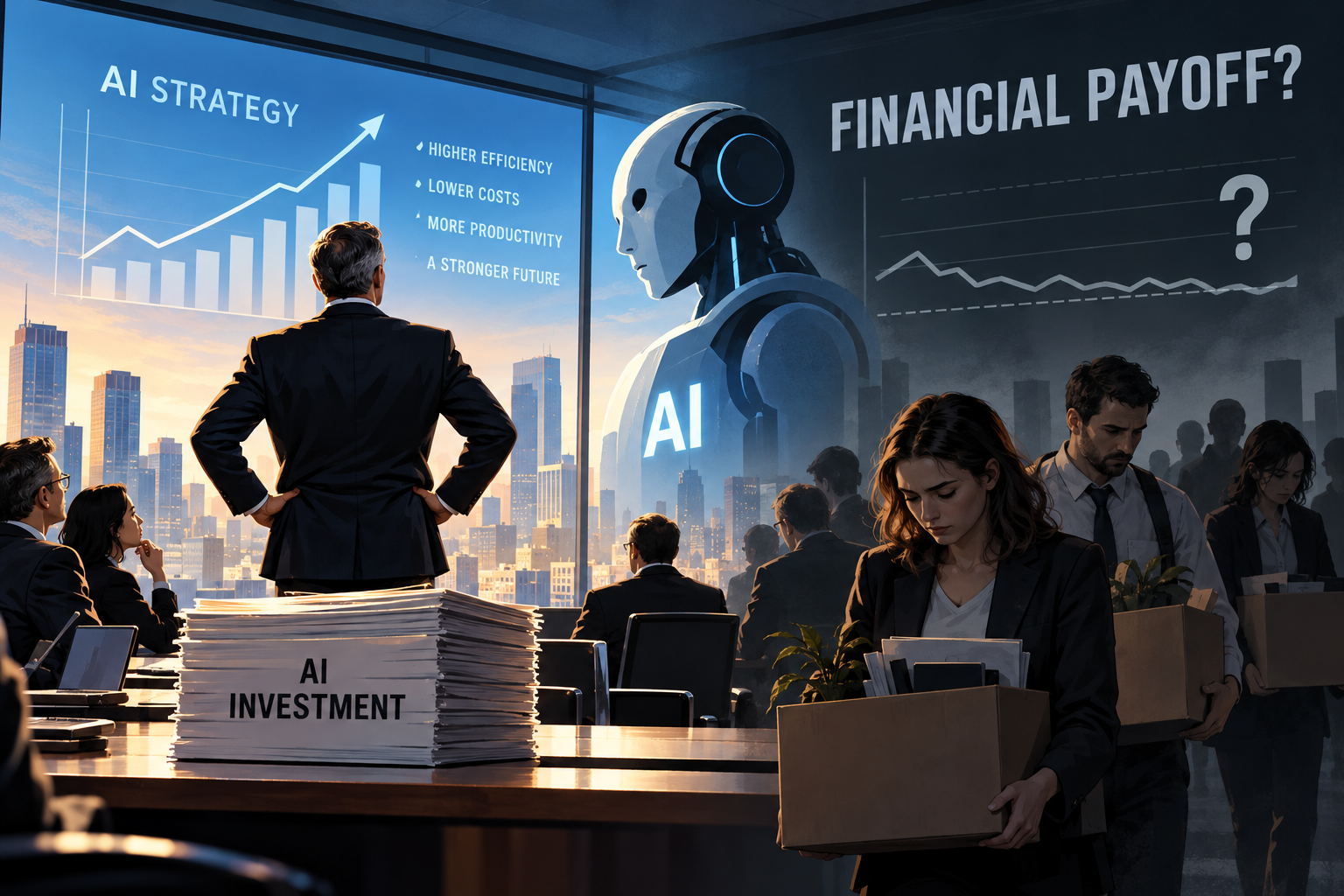
Artificial intelligence is supposed to be transforming American business. Companies are spending billions on it, reorganizing around it, and increasingly telling employees that mastering it is essential to their careers. Some are even citing AI as the reason they're eliminating jobs.
There's just one problem. Outside the technology giants, the promised financial revolution is proving remarkably difficult to find.
That's the uncomfortable conclusion suggested by new research from Apollo Global Management. And it raises a question that deserves considerably more attention than it's receiving: Are American workers already paying the price for an economic transformation that employers have yet to demonstrate is delivering the goods?
This isn't an argument that artificial intelligence is a fraud. It isn't. AI can write software, analyze documents, accelerate research, handle customer inquiries, and perform tasks that once consumed hours of human labor. Some of those capabilities are extraordinary.
But there's a difference between a technology that can do impressive things and one that consistently makes businesses more profitable.
Corporate America has been treating the second proposition almost as an established fact. It isn't.
The Revolution That Hasn't Reached the Bottom Line
On October 24, Torsten Slok, chief economist at Apollo Global Management, published an analysis with a rather inconvenient finding. Despite enormous investments in artificial intelligence, there is little evidence that the technology is producing measurable financial improvements across most of corporate America.
Slok compared the so-called Magnificent Seven technology companies with the remaining 493 companies in the S&P 500. Revenue per employee is rising among the technology giants but remains essentially flat among the others. Profit margins tell a similar story. And broader productivity statistics have yet to show the kind of acceleration that might be expected from a technology supposedly revolutionizing the economy.
Slok's conclusion is emphatic: The AI payoff outside technology hasn't materialized in the numbers.
That doesn't establish that individual businesses aren't benefiting from AI. Some undoubtedly are. Nor does it mean the gains won't arrive later. Technology often takes years to work its way through organizations, particularly when companies must redesign processes, retrain employees, and abandon established ways of doing business.
But those qualifications don't erase the central finding. At a time when artificial intelligence is dominating corporate strategy, its financial benefits remain surprisingly difficult to measure.
And there's additional evidence of the gap between enthusiasm and results.
In an earlier Apollo analysis of second-quarter earnings disclosures, 69% of S&P 500 companies reported having AI in active use. But only 29% disclosed a quantified result, and just 2% reported a metric tracked over time. None separately identified AI's financial contribution as its own performance measure.
In other words, companies are getting very good at telling investors they're using AI. They're considerably less accomplished at demonstrating what they're getting for their money.
The Workers Are Already Feeling the Effects
Now consider what's happening on the employment side of the equation.
Companies are announcing layoffs attributed to artificial intelligence. They're slowing hiring, reconsidering positions they once routinely filled, and asking whether software might absorb work previously performed by employees.
Some are demanding AI proficiency from applicants who might never have been expected to possess technical skills a few years ago. Others are introducing AI competency into employee evaluations, promotions, and compensation decisions.
The assumption behind these changes is understandable. If a company believes AI will allow five employees to accomplish what previously required seven, management has a powerful incentive to reorganize before its competitors do.
But what happens when the anticipated improvement hasn't been demonstrated?
A company doesn't necessarily need to prove that AI has replaced an employee's work before deciding not to replace that employee. It may simply conclude that the technology will eventually make the position unnecessary.
That's a meaningful distinction. The job can disappear today because of savings management expects tomorrow.
And once a position has been eliminated, the company may be reluctant to restore it, even if the anticipated productivity gains fail to materialize.
The remaining employees inherit the work. Management calls it efficiency. The employees may have another word for it.
None of this proves that AI is responsible for every hiring slowdown or restructuring decision. Companies reduce headcount for plenty of familiar reasons, including weak demand, excessive costs, and mistakes made during earlier hiring booms.
Indeed, that is precisely why claims about AI-driven layoffs deserve scrutiny. Announcing a technological transformation can sound considerably more appealing to investors than admitting that a business overexpanded or needs to cut costs.
AI may be a genuine cause of some job reductions, a contributing factor in others, and a convenient explanation for decisions that would have occurred anyway.
The available evidence doesn't always allow us to separate the three.
The Problem With Buying Productivity
There's a seductive simplicity to the corporate AI proposition. Purchase the software, give employees access, automate repetitive work, and watch productivity climb.
Unfortunately, businesses aren't collections of independent tasks waiting to be completed. They're complicated systems involving people, customers, regulations, relationships, judgment, and occasionally spectacularly irrational decisions.
AI can make an individual task faster without making the entire organization more productive.
Suppose an employee uses AI to prepare a report in twenty minutes instead of two hours. That's a genuine improvement. But what if the report requires additional verification? What if the employee spends the recovered time attending another meeting? What if management simply demands three reports instead of one, none of which materially improves a business decision?
The employee is busier. The software is working. The company is paying for the subscription.
Whether the business is actually making more money is another question.
Slok also raises an important concern about the cost of AI itself. Companies must pay for the computing resources required to operate these systems. If the resulting gains aren't substantial enough, AI becomes another operating expense rather than a source of increased profitability.
This isn't the first time corporate America has discovered that purchasing a promising technology is easier than figuring out how to profit from it.
And the problem becomes more complicated when AI produces answers that are plausible but wrong, requires human supervision, or struggles with decisions that depend on organizational context.
Slok makes a particularly interesting observation: Business intelligence is not merely the ability to process information. It also involves judgment, accountability, trust, and an understanding of unwritten rules.
Those aren't minor details. They're often what separates a technically correct recommendation from a disastrous business decision.
What This Means for Job Seekers
There is a temptation to read these findings and conclude that workers should stop worrying about AI.
That would be a serious mistake.
A technology doesn't have to deliver an economy-wide productivity revolution to disrupt individual occupations. A customer-service department might reduce staffing substantially even while the company as a whole struggles to improve profitability. A marketing agency might eliminate junior production roles while continuing to rely heavily on experienced creative directors.
The effects will be uneven, sometimes abrupt, and not necessarily rational.
For job seekers, the lesson is not to ignore AI. It's to understand what employers are actually trying to accomplish with it.
Learning to use AI tools is increasingly sensible. But proficiency alone is unlikely to become a durable competitive advantage. As these tools become cheaper, more accessible, and easier to operate, simply knowing how to prompt a chatbot may distinguish an applicant about as much as knowing how to use a spreadsheet.
What matters is what the applicant can accomplish.
A marketing professional who can demonstrate how AI helped improve campaign performance has something valuable to offer. So does an operations manager who used it to reduce processing errors, or an analyst who accelerated research without compromising accuracy.
The important words are demonstrate and without compromising accuracy.
Employers may be enthusiastic about AI, but they still need employees who understand their businesses, recognize mistakes, exercise judgment, and take responsibility for results.
This is particularly relevant to experienced workers who worry that younger applicants possess an insurmountable advantage because they've grown up with newer technologies.
Experience isn't automatically valuable, any more than familiarity with AI is automatically valuable. But experience combined with technological adaptability can be a powerful proposition.
Knowing how to produce an answer is useful. Knowing whether the answer makes sense can be considerably more important.
For applicants, that suggests a practical strategy: Don't merely tell an employer you're comfortable with AI. Show how you would use it to solve a problem the employer actually has. Explain what you'd measure, what could go wrong, and where human judgment remains necessary.
That is a much more persuasive argument than adding another software name to the skills section of a résumé.
The Danger of Managing by Prediction
The most troubling possibility is that some companies are restructuring their workforces around a future that has not yet arrived.
That doesn't necessarily make their decisions unreasonable. Business leaders are paid to anticipate change, not merely respond after competitors have moved.
But there is a difference between preparing for technological progress and assuming its financial benefits are inevitable.
Consider what happens when a company reduces entry-level hiring because it expects AI to perform much of the routine work once assigned to junior employees.
In the short term, the company may save money. In the longer term, it may discover that it has weakened the pipeline of employees who would eventually become its experienced managers, specialists, and decision-makers.
Or consider a company that reduces its workforce while expecting AI to increase the productivity of those who remain. If the technology underperforms, the organization may find itself short of people, overloaded with work, and less capable of serving customers.
Neither outcome is inevitable. But both are risks that deserve attention.
The irony is that companies could damage the human capabilities they will need most if AI turns out to be less autonomous, less reliable, or less profitable than anticipated.
The experienced employee who knows why a customer is unhappy, which supplier cannot be trusted, or why an apparently sensible policy failed five years ago may possess precisely the institutional knowledge that makes AI useful in the first place.
Eliminate that employee, and the company may discover that its shiny new technology has lost an important source of context.
The Next Phase of the AI Revolution
There are two broad possibilities.
The optimistic one is that today's investments are laying the foundation for substantial productivity gains that will become visible over the next several years. Companies will learn how to integrate AI into their operations, costs will decline, and entirely new products and services will emerge.
History offers reasons to take that possibility seriously.
The less comfortable possibility is that AI will prove enormously useful in some activities but considerably less transformative across the broader economy than its most enthusiastic advocates predict.
In that scenario, some businesses will still prosper. Others will discover that they spent heavily on technology without developing a convincing economic justification for doing so.
And some workers will have lost jobs in anticipation of efficiencies that never fully arrived.
These outcomes aren't mutually exclusive. AI could transform particular industries while delivering disappointing aggregate returns. It could eliminate certain occupations while creating demand for others. It could make individual employees more productive without producing the corporate profit explosion investors expect.
That complexity is precisely what gets lost in the endless procession of announcements about AI investment, adoption, and workforce transformation.
We hear plenty about what artificial intelligence is going to do. We hear much less about what it has demonstrably accomplished.
The Question Employers Should Be Answering
Slok's research is not the final verdict on artificial intelligence. It is a snapshot of an evolving technology and an economy still learning how to use it.
But it's a valuable corrective to the assumption that the business case has already been settled.
The next time a company announces that it's eliminating positions because of AI, investors, employees, and journalists ought to ask a few questions.
What work has actually been automated? What savings have been measured? Have those savings exceeded the costs of implementation, supervision, and maintenance? And is the company reducing employment because AI has already improved productivity, or because management believes it eventually will?
Those questions aren't hostile to innovation. They're ordinary questions of business accountability.
For workers, meanwhile, the sensible response remains the same: Learn the technology, understand its limitations, and develop evidence of the value you can create with it.
Don't assume AI is going away. Don't assume every employer claiming to have mastered it actually has.
And don't confuse the confidence of a corporate announcement with proof of a financial result.
Artificial intelligence may eventually transform the economics of American business. It may even exceed today's most ambitious expectations.
But until the evidence catches up with the promises, one uncomfortable fact remains.
Corporate America is already making employment decisions based on the AI revolution. The financial returns are still being counted.
Research and further reading
Torsten Slok, Apollo Global Management, October 24, 2026 — No Signs of AI Payoff Outside the Tech Sector
Apollo Global Management, September 2026 — From Who Is Deploying AI to Who Can Prove the ROI