
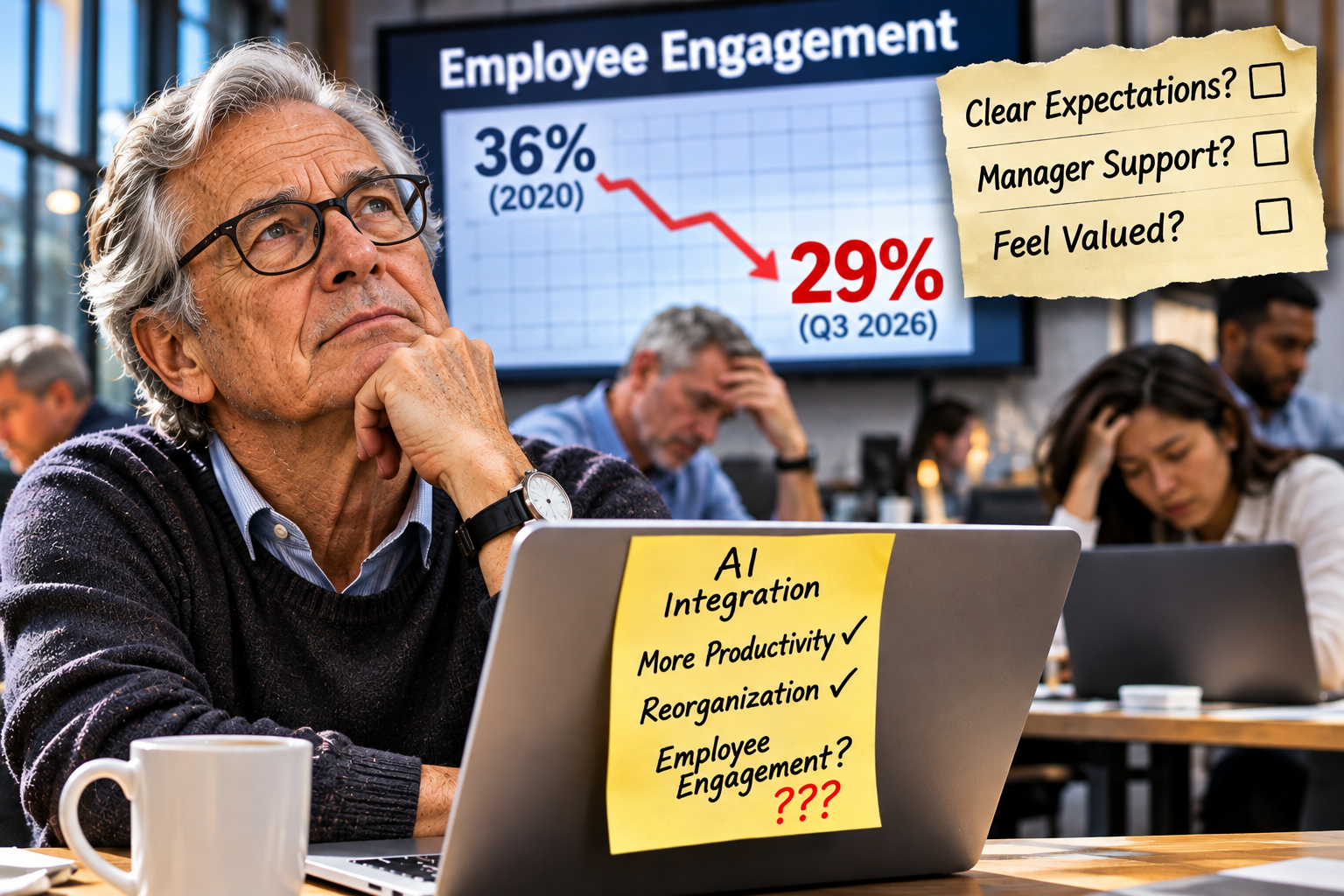
American workers are increasingly disconnected from their jobs, and the latest numbers suggest the problem is getting worse.
Gallup's October 28 report found that employee engagement dropped to 29% in the third quarter of 2026, its lowest level since 2011. That's down from 31% earlier this year and a peak of 36% in 2020.
A two-percentage-point quarterly decline may not sound especially dramatic. But Gallup estimates it represents approximately 3.2 million fewer engaged employees in just three months.
The deterioration is particularly noticeable among employees working remotely or on hybrid schedules, especially at companies introducing AI into their operations.
At the same time, fewer workers understand precisely what is expected of them, and fewer believe anyone at work genuinely cares about them.
Technology is advancing. Employee enthusiasm is heading in the opposite direction.
What the Evidence Shows
Gallup's findings reveal several developments worth examining.
Engagement is falling across the workforce. Only 29% of employees are engaged, while 53% are not engaged and another 18% are actively disengaged. Since 2020, the number of engaged American workers has declined by approximately 11 million.
Remote workers are experiencing the sharpest deterioration. Engagement among fully remote employees fell five percentage points between the second and third quarters of 2026. Hybrid employees experienced a two-point decline. On-site employees saw a smaller decline of approximately one point.
Workers are increasingly uncertain about expectations. Only 46% strongly agreed that they knew what was expected of them at work, down from 49% earlier in the year.
The personal connection is weakening. Just 37% strongly agreed that their supervisor or someone at work cared about them as a person. That figure stood at 47% in March 2020.
The AI findings are particularly revealing.
Earlier Gallup research suggested that AI adoption could actually improve engagement when accompanied by clear organizational plans and supportive management. Among employees who frequently used AI, understood their organization's AI strategy, and received active managerial support, engagement reached 53%.
But the latest results show that the engagement advantage associated with AI adoption has narrowed sharply among remote and hybrid workers.
For hybrid employees, the engagement advantage at AI-integrated organizations fell from eight percentage points to just two. Among fully remote workers, it narrowed from five points to two.
These findings establish an association, not causation. Gallup has not demonstrated that AI itself is making employees unhappy.
What the research does suggest is that technology may be changing the workplace faster than organizations are preparing employees to function within it.
What's Really Going On
Corporate America has developed considerable enthusiasm for artificial intelligence. The promised benefits are familiar: greater productivity, lower costs, faster decisions, and fewer hours spent on routine tasks.
Employees, however, may have a somewhat different set of questions.
Will AI make my job easier? Will it change what I'm expected to accomplish? Will the company use it to eliminate positions? And if I'm supposed to become more productive, does that mean I'll be expected to do the work of two people?
These aren't unreasonable concerns.
For decades, employers have introduced technologies that promised to make work more efficient. Sometimes the improvements genuinely benefited employees. Sometimes they simply raised performance expectations or reduced staffing.
AI brings another dimension to that familiar uncertainty because its potential applications extend into professional, analytical, administrative, and creative work once considered relatively secure.
Remote and hybrid employees may be particularly vulnerable to the uncertainty.
Working outside the office can provide considerable advantages, including flexibility, independence, and freedom from commuting. But it can also reduce informal communication. Employees may miss the conversations that help them understand organizational priorities, management expectations, and changes taking place around them.
Gallup suggests that physical distance may contribute to psychological distance.
Now introduce AI into that environment.
A worker who rarely sees a supervisor may receive instructions to use new AI systems without much explanation of how those systems will affect responsibilities, performance evaluations, or long-term employment prospects.
The employee is expected to adapt. Management may still be figuring out what adaptation means.
There is, however, another side to the story.
Gallup's earlier findings suggest that employees can respond positively to AI when they understand its purpose and receive appropriate support. The technology may eliminate tedious work, improve access to information, and give people more time for judgment, problem-solving, and creative work.
That possibility shouldn't be dismissed.
But handing employees an AI subscription and announcing a productivity initiative is hardly the same thing as managing technological change.
Companies may be investing millions in the machinery while neglecting the people expected to operate it.
What It Means for You
For employed workers, particularly those in remote or hybrid positions, these findings offer a useful warning.
Your job may be changing even if your title, compensation, and formal responsibilities haven't changed.
AI adoption can alter how employers evaluate performance, allocate assignments, and determine staffing requirements. Some changes will create opportunities. Others may reduce demand for particular skills or functions.
The difficulty is knowing which changes are coming and where you fit.
For job seekers, the implications are somewhat different.
Employers increasingly want candidates who can work effectively with AI, but that doesn't necessarily mean they have clearly defined what those skills involve. A job posting may call for AI proficiency without explaining which systems employees will use or how success will be measured.
Candidates should be prepared to ask those questions.
And for workers contemplating a career change, the broader lesson is that technological competence alone may not provide much protection. The ability to exercise judgment, solve unfamiliar problems, communicate effectively, and take responsibility for outcomes may become increasingly valuable as routine tasks are automated.
An employee who understands how to use AI is useful. An employee who understands when AI is wrong, what it cannot do, and how to turn its output into a sound business decision may be considerably more valuable.
What to Do Now
1. Find out what your employer's AI plans actually mean for your job. Ask your supervisor which responsibilities are expected to change over the next six to twelve months. Find out what new capabilities will be required and how performance will be evaluated. Don't settle for general assurances that AI will make everyone more productive.
2. Make your contributions visible. Especially if you work remotely, document completed projects, measurable results, problems solved, and improvements you've introduced. Keep a private record of accomplishments that can support performance discussions, résumé updates, and future job applications, without retaining confidential employer information.
3. Develop skills that complement automation. Learn the AI tools relevant to your profession, but concentrate equally on the judgment required to use them effectively. Understanding the business problem, evaluating results, managing relationships, and making decisions remain important capabilities.
4. Ask better questions during job interviews. Find out how the employer is implementing AI, what training is provided, and whether responsibilities have changed. Ask how the organization expects the position to evolve. An employer that cannot explain what the job will look like in a year may be telling you something important.
5. Keep your options open. Even if you're satisfied with your current position, maintain professional relationships, update your résumé, and pay attention to developments in your occupation. You don't need to conduct a full-scale job search. You do need to know where you would begin if circumstances changed.
The Larger Picture
The decline in employee engagement began well before the current AI boom. Poor management, organizational uncertainty, inadequate communication, and declining confidence in employers are hardly new developments.
AI may be intensifying those problems, but it didn't invent them.
What makes the current situation different is the speed and potential scale of the transformation. Companies are experimenting with technology capable of changing not only how employees work but how many employees they need.
That makes communication, credibility, and trust more important, not less.
For employers, the message from Gallup is straightforward: successful AI adoption requires more than software licenses and productivity targets.
For workers, the message is equally practical. Understand what's changing, find out where you fit, and prepare for the possibility that the organization itself may not yet know.
The machines may be getting smarter.
Someone should probably tell the employees what's going on.
Sources
Gallup, Jim Harter, October 28, 2026. U.S. Employee Engagement Below 30% for First Time in 15 Years.
Gallup, Jim Harter, July 21, 2026. Employee Engagement Remains Flat as AI Adoption Accelerates.