
Reading the economic headlines over the past few days, you might think the American economy had suddenly emerged from behind the curtain, grinned at the audience, and announced, "All that scary data? Just kidding!"
The economy added 165,000 jobs in October, beating expectations. Unemployment fell to 4.1%. Earlier employment estimates were revised upward. Manufacturing showed signs of life, and professional and business services had a particularly good month.
CNN reported that the economy had added 165,000 jobs and unemployment had fallen. Other coverage emphasized stronger-than-expected hiring and the remarkable resilience of the American economy. Even the political conversation has turned to whether the Democratic gains in the midterm elections might give the recovery another push.
You can hardly blame the news media for looking for a positive story. Good news sells newspapers, too, and after months of layoffs, hiring freezes, inflation worries, AI anxiety, and general economic gloom, a little encouragement is practically irresistible.
Besides, the October numbers really were better. There's no reason to pretend otherwise.
But before we start congratulating ourselves on the great American employment recovery, there's something worth remembering.
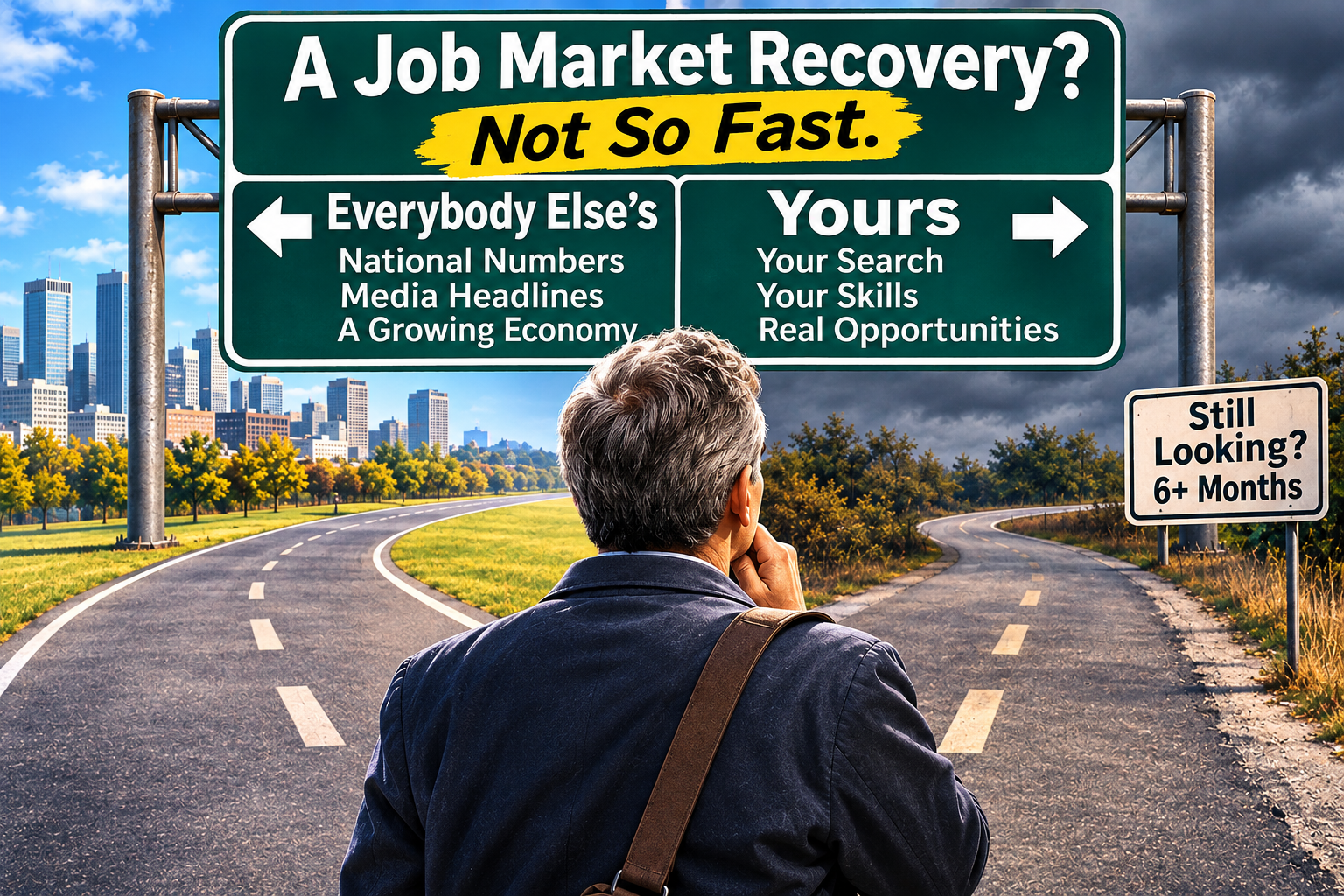
There are two job markets: yours and everybody else's.
Everybody else's is the one economists measure, politicians celebrate, and financial markets react to. It produces the headlines, the monthly statistics, and the occasional breathless announcement that the economy has finally turned the corner.
Yours is the one where you actually have to find a job.
The economy can add 165,000 jobs without creating a single suitable opening for you. The unemployment rate can fall while your search stretches into its seventh month. Employers can announce ambitious hiring plans while your applications continue disappearing into the digital void.
So let's welcome the good news. But before declaring the job market fixed, a few observations are in order.
The Curious Case of the Vanishing Jobs
We've been following the employment numbers for months at BrokenJobMarket.com, including their curious tendency to change after the headlines have been written and everybody has moved on to something else.
Remember the vanishing jobs?
Earlier this year, revisions erased substantial numbers of jobs from previous estimates. Positions that had appeared in the original reports were subsequently removed from the totals. Now October brings the opposite experience. The Bureau of Labor Statistics revised August employment upward by 53,000 jobs and September by another 31,000.
Presto. Another 84,000 jobs.
Apparently, some of the missing jobs have been located.
There's nothing sinister about this. The BLS publishes preliminary estimates based on employer surveys, then revises them as more information becomes available. It's a perfectly legitimate statistical process, although it does make for some interesting journalism.
The problem arises when preliminary numbers are treated as the final verdict on the economy. Today's encouraging figure may look different in December, and December's numbers may change in January. We've seen enough revisions this year to know that the first report isn't necessarily the last word.
October was a good month. Let's see whether November and December agree.
A Recovery With a Waiting Room
While the headlines celebrated the 165,000 new jobs, another statistic received considerably less attention.
More than one in four unemployed Americans has been out of work for at least 27 weeks.
The October figure was 27.6%, representing approximately two million people. That's roughly six months or longer without a job, and the proportion actually increased slightly from September, even as the overall unemployment rate declined. CNBC reported that the long-term unemployed represented their highest share since late 2021, while the average unemployment spell exceeded 27 weeks for the first time outside the pandemic since 2016.
Some of these people have been searching considerably longer. They include experienced professionals who spent years building careers, only to discover that replacing a lost position can be considerably more difficult than performing it.
For them, the recovery is something they're reading about.
And then there are the 4.8 million Americans working part-time for economic reasons, an increase of 339,000 in October. These are people who want full-time employment but can't obtain it or whose employers have reduced their hours.
They're counted as employed. Their financial problems haven't necessarily been solved.
The national unemployment rate is useful, but it doesn't tell us how difficult it is to find work, whether the available jobs match the qualifications of people seeking them, or how long the search is taking.
Those details tend to get lost in the celebration.
The Recovery Isn't Reaching Everyone
The national unemployment rate fell to 4.1% in October, but the improvement was hardly universal.
Black Americans: Unemployment stood at 6.6%, compared with 3.7% for White Americans. Although the rate edged down from 7.0% in September, the persistent gap remains substantial.
Teenagers and young adults: Unemployment among 16- to 19-year-olds was 13.9%, more than three times the national rate. For workers ages 20–24, it was 7.5%. Getting that first foothold in the workforce remains difficult.
Older workers: Unemployment among Americans 55 and older edged up to 2.8% in October. AARP reports an average unemployment duration of 34.1 weeks for ages 55–64, compared with 25.3 weeks for ages 20–24. Keeping a job and finding a replacement can be very different experiences.
These figures deserve more attention than a footnote in an otherwise upbeat employment report. We'll examine the problems facing Black workers and older job seekers in separate articles.
Source: Bureau of Labor Statistics, October 2026 employment data.
The Jobs Are Coming Back. Just Not Everywhere.
Professional and business services added 70,000 jobs in October. Healthcare continued expanding, as did transportation and warehousing. Manufacturing showed encouraging signs of renewed activity.
That's welcome news, although it presents an obvious problem for displaced workers.
A hospital may need nurses, technicians, and therapists. That doesn't create an immediate opportunity for an unemployed marketing manager. A manufacturing company may need engineers and machinists, but the demand for those skills offers little consolation to a former corporate communications executive.
Economists call this a mismatch between labor supply and demand. Job seekers have a less elegant explanation: There are jobs out there, but not jobs I can get.
The mismatch is particularly troublesome for experienced white-collar workers whose careers developed in organizations that employed large numbers of people to manage information, supervise departments, coordinate projects, and keep complicated operations functioning.
Some of those functions are now being consolidated, automated, outsourced, or redistributed among smaller teams. The work may still need to be done, but employers may need fewer people to do it.
Which brings us to artificial intelligence.
The AI Elephant in the Employment Office
In CNN's November 6 examination of the labor market, PNC chief economist Gus Faucher suggested that AI has not yet transformed employment in a broad economic sense.
He may be right. We haven't seen a wholesale collapse in employment attributable to artificial intelligence. Some corporate announcements blaming layoffs on AI may also exaggerate its actual contribution.
But there's another possibility that doesn't attract nearly as much attention.
Suppose a company employs ten people to handle administrative, research, reporting, and communications responsibilities. With AI tools, perhaps eight people can accomplish much of the same work.
Nobody gets fired. Two employees retire, and management decides not to replace them.
No dramatic layoff announcement. No robots marching through the office carrying cardboard boxes. The company may even report excellent earnings.
But two potential jobs have disappeared.
That's a hypothetical example, not a measured national trend. It illustrates why looking only at layoffs may tell us relatively little about AI's eventual impact on hiring.
Employers can reduce replacement hiring, leave vacancies unfilled, and change job requirements without ever announcing an AI-related layoff. Some may also expand without adding employees at the rate they once would have.
We don't yet know how widespread these effects will become. But anyone looking for work in an occupation exposed to AI would be foolish to ignore the possibility.
The immediate question for job seekers is whether employers are changing what they expect from the people they hire, and whether their own qualifications are keeping pace.
Don't Expect Congress to Deliver Your Next Job
CNN's Alicia Wallace raised an interesting question following the midterm elections: Could the Democratic gains in Congress help revive the labor market?
Possibly. Reduced uncertainty over tariffs, energy prices, and other economic conditions could encourage businesses to invest and hire. State governments may also have opportunities to address housing costs, transportation, and other obstacles to economic growth.
But political changes take time, and a divided federal government has limited room to maneuver.
There are risks ahead as well. Economist Diane Swonk warned that Medicaid changes scheduled for January 1, 2027 could strain state and local governments administering the programs, especially in rural and lower-income communities. That's worth watching because healthcare has been one of the country's most dependable sources of employment growth.
Meanwhile, the larger forces reshaping work aren't waiting for Congress. An aging population, changing immigration patterns, technological advances, and employers' continuing efforts to operate with fewer people will remain part of the economic landscape.
A favorable election result may improve confidence. It won't necessarily get an unemployed accountant an interview next Tuesday.
What the Numbers Mean for Your Search
If you're employed and considering a change, October's report provides some reason for cautious optimism. A stronger labor market can create opportunities, particularly in industries that are expanding.
If you've been unemployed for several months, however, I'd be careful about assuming that your old job market is coming back.
It might. But it may return with different employers, different qualifications, and fewer openings for some familiar positions.
After six months without meaningful progress, submitting another hundred applications in exactly the same way probably isn't the answer. It's time to examine the evidence.
Are you getting interviews? If not, is the problem your résumé, the positions you're targeting, or the qualifications employers now require? If you're reaching interviews but not advancing, what are employers telling you? Are you concentrating on an industry that's still shedding workers while overlooking adjacent fields where your experience might be useful?
And how much of your search depends on advertised vacancies rather than people who can tell you where genuine hiring is taking place?
These aren't particularly comfortable questions. After months of searching, the last thing anyone wants is another examination of their efforts. But continuing a strategy that isn't producing results is unlikely to improve matters.
It may be time to reconsider job titles, explore related industries, learn unfamiliar tools, or take contract work while pursuing something permanent. Some people will need to accept that the position they held five years ago is no longer being filled in quite the same way.
None of this guarantees success. The market is difficult, and some obstacles are beyond an individual's control.
But understanding where your search is breaking gives you something useful to work with.
Your Job Market Is the One That Counts
October's employment report was encouraging. Employers added jobs, earlier estimates improved, and several important industries showed renewed strength.
But nearly two million Americans have been unemployed for six months or longer. Millions more are working fewer hours than they want. Young workers are struggling to enter the workforce, and Black Americans continue to face substantially higher unemployment than White Americans.
These realities can coexist with a strengthening national economy. They frequently do.
Everybody else's job market is enormous. It includes millions of employers, hundreds of occupations, thousands of communities, and enough statistics to keep economists busy indefinitely.
Your job market is considerably smaller. It consists of the employers who might actually hire you, the skills they're willing to pay for, the competition you're facing, and the opportunities available where you live or are willing to work.
That's the market you need to understand.
So enjoy the encouraging headlines. We certainly could use a few.
Just don't confuse an improving national economy with an improving personal job search.
There are two job markets: yours and everybody else's.
And yours is the one where you have to get hired.
Free Resource: The Six-Month Job Search Audit
If you've been looking for work for six months or longer, our free Six-Month Job Search Audit can help identify where your search is stalling and what to change over the next 30 days.
Start the Six-Month Job Search Audit
Sources
U.S. Bureau of Labor Statistics, The Employment Situation — October 2026, November 6, 2026.
Alicia Wallace, "Could the 'blue tsunami' jolt the US job market back to life?" CNN Business, November 6, 2026.
U.S. Bureau of Labor Statistics, October 2026 household and establishment survey tables.
BrokenJobMarket.com, previous reporting on payroll revisions and the Labor Market Pulse.
Alicia Wallace, "The US economy added 165,000 jobs in October and the unemployment rate fell," CNN Business, November 6, 2026.
AARP, "October Jobs Report: What It Means for Older Workers," November 2026.
CNBC, reporting on long-term unemployment and average jobless duration, November 2026.