
If your job search feels like you're throwing resumes into a freezer, there may be a simple reason: you may be looking in the wrong part of the market.
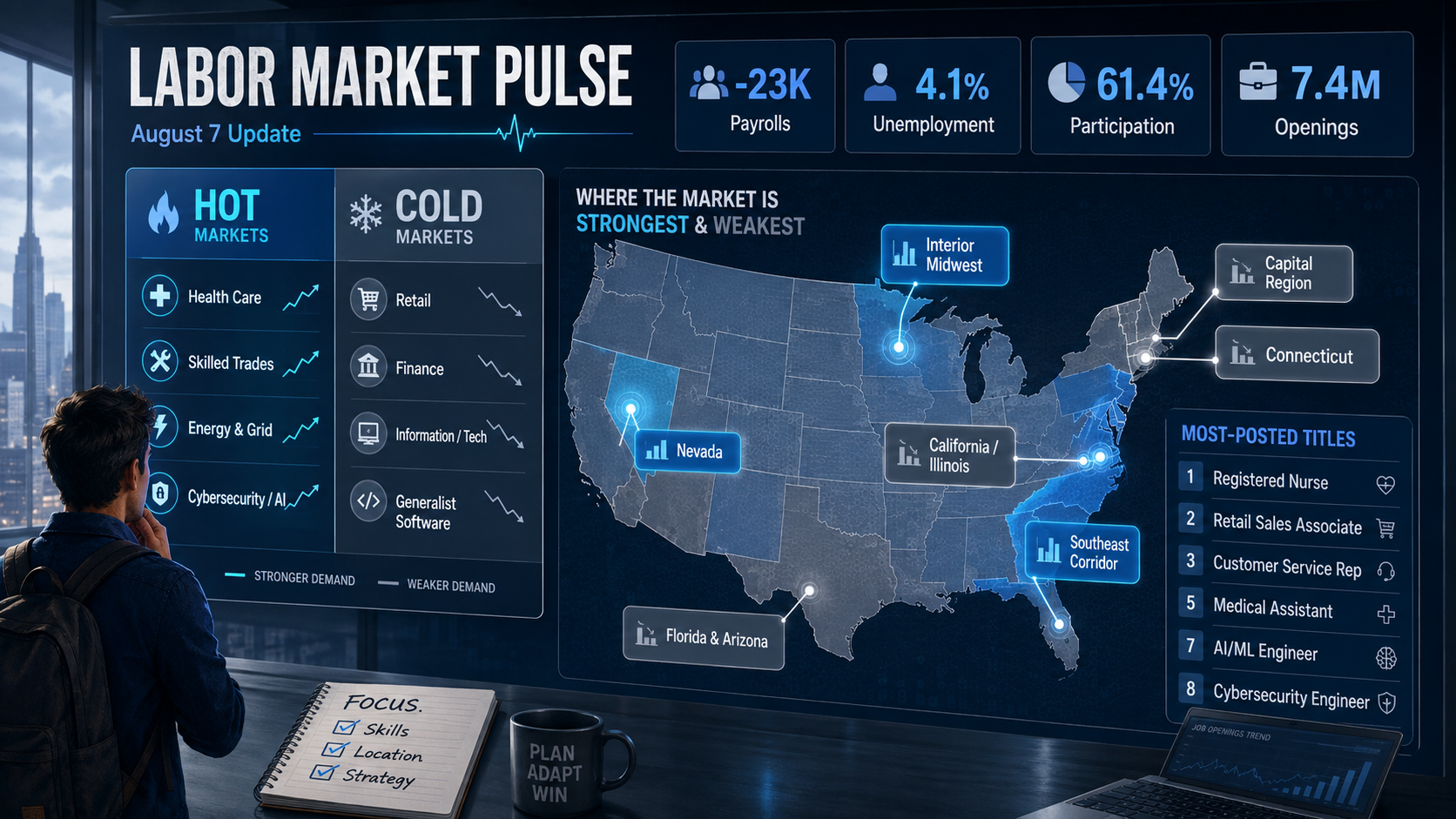
The latest Cranky Labor Market Pulse shows a labor market that isn't moving in one direction. Some fields are still hiring aggressively. Others are barely moving. A few are quietly shrinking while continuing to post thousands of openings.
For job seekers, that distinction matters more than the national unemployment rate.
The hottest place to be: health care
Health care remains the strongest large employment sector in the country. It added another 22,000 jobs in July, even though that was slower than its recent monthly average of 36,000.
And the job-posting numbers tell the same story.
Registered Nurse is the most-posted job title in the country. Medical Assistant and Licensed Practical Nurse also make the top ten. Health care and health-care-adjacent jobs account for an extraordinary share of the positions employers are actively trying to fill.
You don't necessarily need to become a nurse. Hospitals, clinics, long-term-care facilities and medical systems employ people in operations, technology, billing, administration, sales, communications and dozens of other functions.
If you have transferable skills, health care is worth putting on your target list even if you've never worked in health care before.
The other hot spots aren't surprising
Skilled trades and specialty construction remain structurally strong, particularly jobs that can't easily be automated, outsourced or performed by someone sitting 5,000 miles away.
Energy and grid infrastructure also continue to look promising.
And technology isn't dead. It's becoming much more selective. Cybersecurity and applied AI/ML are hot; generic tech is not. AI/ML Engineer is among the fastest-growing titles in the market, while cybersecurity postings are up more than 120% year over year in the Pulse data.
That's an important distinction for anyone considering a career pivot. 'I work in tech' isn't much of a strategy anymore. Which part of tech? matters enormously.
Now for the cold water
Retail took a noticeable turn for the worse in July, losing 19,000 jobs, particularly among warehouse clubs, supercenters and gas stations. Financial activities lost another 14,000 and are now down 121,000 jobs from their May 2025 peak. Information and general technology employment also remain well below their earlier peak.
The structurally weaker areas in the Pulse now include big-box retail, back-office finance and insurance, generalist software engineering and local-government education.
That doesn't mean there are no jobs. It means you should expect a tougher fight for them.
And don't confuse lots of job postings with a healthy career market.
Retail Sales Associate is the second-most-posted job title in America. Customer Service Representative is third. Store Manager is fourth. But much of that hiring reflects churn — employers replacing people who leave — rather than expanding businesses creating new positions.
Administrative Assistant is another revealing example. It's still one of the country's most frequently posted jobs, even as AI and automation increasingly absorb parts of the work.
A posting is not the same thing as growth.
Geography matters more than people think
Where you live can also change the odds.
The latest available regional data still shows North Carolina among the stronger markets, adding 61,800 jobs over the year. Nevada grew even faster on a percentage basis, up 1.8%. Indiana, Iowa and South Dakota continue to post low unemployment rates, making the interior Midwest considerably healthier than its reputation might suggest. Massachusetts and Rhode Island have also been improving.
At the other end, Florida and Arizona have been cooling. California and Illinois are running unemployment rates well above the national average. Connecticut has experienced one of the sharpest deteriorations, while Washington, D.C. and parts of Virginia continue to absorb the effects of federal-government cuts.
One caution: the state data trails the national numbers, and the next regional update is due August 21. So treat this as a direction-of-travel indicator, not yesterday's weather report.
For remote workers especially, though, geography can become part of the search strategy instead of simply something that happens to you.
Job openings are slipping, too
The hiring pipeline isn't collapsing. It's just getting narrower.
There were about 7.4 million job openings in June, down from 7.6 million in May. Hiring held at roughly 5.3 million, and quits remained subdued. Employers aren't laying people off en masse — but they aren't rushing to hire replacements either.
That's the strange market job seekers are confronting: low firing and low hiring at the same time.
Which helps explain why someone with a job may feel reasonably secure while someone trying to get one feels as though every opening has 400 applicants.
What I would do with this information
Don't just ask, What jobs can I apply for?
Ask, Where is demand moving toward me instead of away from me?
If you're in health care, skilled trades, energy infrastructure, cybersecurity or applied AI, the current is generally helping you.
If you're in retail, generalist tech, back-office finance or administrative work, you're swimming against it.
That doesn't mean abandoning a career you've spent 20 years building. It may mean widening the industries you target, sharpening your specialty, adding a credential, repositioning your experience or looking at a healthier geographic market.
The biggest mistake would be to keep sending the same resume to the same kind of employer in the same cold part of the market — and conclude that you are the problem.
Sometimes the most useful job-search advice isn't to try harder.
It's to move ten feet down the beach and fish where the fish are.