
By Charlie O'Neill
There may be some encouraging news for job seekers as we approach the end of 2026. But before anyone breaks out the champagne, there are also some rather peculiar developments taking place inside the hiring process itself.
Let's start with the potentially good news.
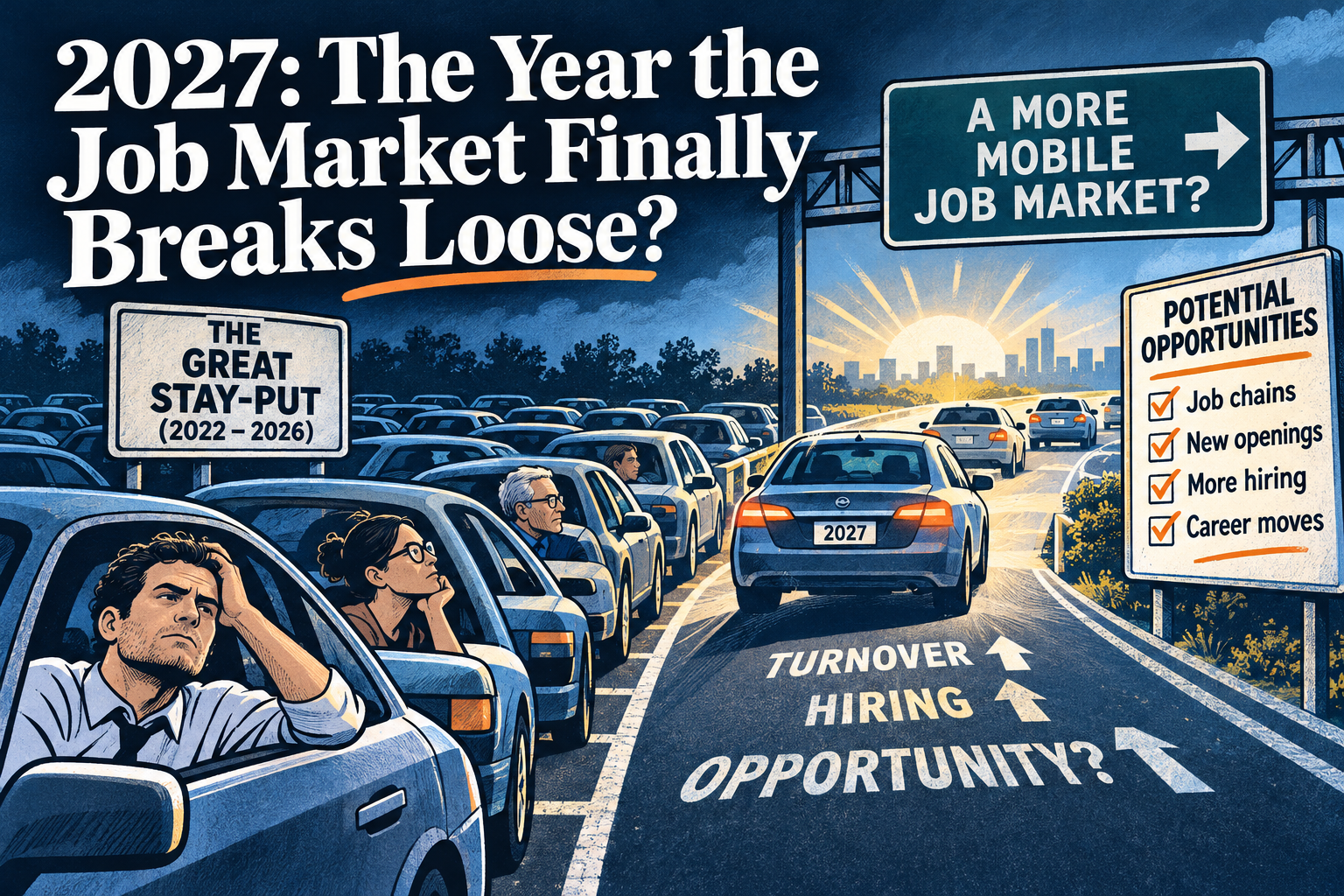
The Great American Stay-Put
For nearly three years, the American labor market has been characterized by relatively low hiring and low firing. Millions of employees who would ordinarily be looking for something better have been sitting tight, reluctant to give up a paycheck in an uncertain economy.
In their 2027 U.S. Hiring and Worklife Trends Report, economists at Indeed and Glassdoor estimate that Americans are quitting their jobs at a rate roughly 349,000 per month below what current levels of worker dissatisfaction would predict.
Fear has become a remarkably effective employee-retention program.
But if hiring improves in 2027, some of those dissatisfied employees may finally decide to move on. Their departures could create a chain of vacancies, generating opportunities even at companies that have no plans to expand their workforces.
For people who have been unemployed for several months, this could be a particularly welcome development.
There are, of course, some important qualifications. Employers may use voluntary departures as opportunities to automate or eliminate positions. And increased turnover among highly sought-after professionals won't necessarily translate into opportunities for everyone else.
The number we'll be watching particularly closely is actual hiring. More people leaving their jobs won't accomplish much for unemployed Americans unless employers are prepared to replace them.
We've explored this possibility in considerably more detail in a separate article published this week, 2027: The Year the Job Market Finally Breaks Loose?, available at BrokenJobMarket.com.
Meanwhile, Inside the Hiring Machinery
While economists are debating whether the labor market will finally loosen up, the mechanics of getting hired continue to change. Several recent reports have caught our attention, and we'll be examining them over the coming week.
Is your résumé too good to be believed?
After encouraging job seekers to tailor their résumés to individual job descriptions, the employment industry now appears to be developing suspicions about applications that look a little too perfect.
A new report from Greenhouse found that nine in ten U.S. employers believe they have turned away real candidates because their applications seemed fake or AI-generated.
Imagine spending hours trying to produce the perfect résumé, only to discover that its perfection has become a reason to reject you.
We'll be looking at how candidates can use AI constructively without sacrificing their credibility or individuality.
When did the job interview become an unpaid consulting assignment?
Employers increasingly ask candidates to complete projects, prepare presentations, develop marketing strategies, analyze data or solve business problems as part of the interview process.
In a Monster survey earlier this year, 59 percent of workers said unpaid assignments or extensive take-home work would make them least likely to apply for a job.
There's certainly nothing unreasonable about an employer wanting evidence that a candidate can do the job. But there ought to be some limits.
If a prospective employer asks you to spend an entire weekend developing a marketing strategy for its business, are you being interviewed or have you simply acquired your first unpaid consulting client?
We'll examine where candidates might reasonably draw the line and how they can negotiate the scope of these assignments without unnecessarily jeopardizing their prospects.
Would you kindly prove you exist?
Concerns about fraudulent applications, impersonation and AI-assisted interview cheating are prompting some employers to introduce additional identity-verification procedures. In a recent Checkr survey of 3,000 U.S. hiring managers, 40 percent said they had interviewed a candidate later found to be using a fake identity, up from 31 percent a year earlier.
For legitimate candidates, this creates another set of complications. What constitutes a reasonable request from a prospective employer? What information should you be reluctant to provide? And how do you distinguish a legitimate verification procedure from an employment scam?
Apparently, demonstrating that you're qualified for a job may increasingly be preceded by demonstrating that you're an actual person.
Using AI to interview your prospective employer
Here's a development we find particularly encouraging.
Job seekers are beginning to use artificial intelligence to investigate prospective employers before deciding whether to apply or accept an offer.
AI can help candidates examine a company's financial condition, management turnover, competitive position, history of layoffs, compensation practices and reputation as an employer. The findings, of course, need to be independently verified.
For years, employers have had increasingly sophisticated tools for evaluating candidates. Candidates now have access to some rather sophisticated research tools of their own.
We'll be developing a practical guide to using them.
Could an AI interview actually work to your advantage?
Judging from the comments we've seen online, job seekers have approximately the same enthusiasm for being interviewed by an AI avatar as they do for calling their health insurance company.
But recent survey research suggests that some candidates and employers are finding benefits in AI-assisted interviews.
Could these systems provide opportunities for qualified candidates who might otherwise never get past the initial screening process? Could they give more applicants a chance to demonstrate their abilities?
We're not prepared to endorse the technology simply because its developers tell us it's wonderful. Nor are we prepared to dismiss it simply because the experience can be unpleasant.
We'll examine the evidence, including the limitations of the research and the practical implications for candidates.
Looking Ahead
One of the more frustrating aspects of today's job market is that the rules keep changing, and nobody seems particularly interested in explaining the new rules to the people looking for work.
Candidates are encouraged to use artificial intelligence and then potentially penalized for using it. They're told to demonstrate their skills, sometimes through assignments requiring hours of unpaid labor. They're expected to be transparent with employers who may reveal remarkably little about their own hiring intentions.
And all of this is taking place in a labor market where getting an interview remains a considerable accomplishment.
If the employment market does become more active in 2027, candidates who understand these developments may be better positioned to take advantage of the opportunities that emerge.
Over the coming week, we'll be publishing articles on each of these subjects, with an emphasis on practical steps job seekers can take.
In the meantime, don't wait for economists to announce that the job market has recovered before preparing yourself for the possibility that it might.
A Thanksgiving Thought
And, by the way, Happy Thanksgiving.
Do yourself a favor. Try to step off the job-search treadmill, even if it's just for the day. Put the résumé aside, stay away from the job boards, and focus on what's really important: your relationships with family and friends.
A prolonged job search has a way of consuming your life and distorting your sense of who you are. Remember that the people who care about you are unlikely to measure your worth by your employment status, your job title or the number of interviews you've had this month.
Enjoy their company. Have another piece of pie.
The job market will still be there on Friday.