
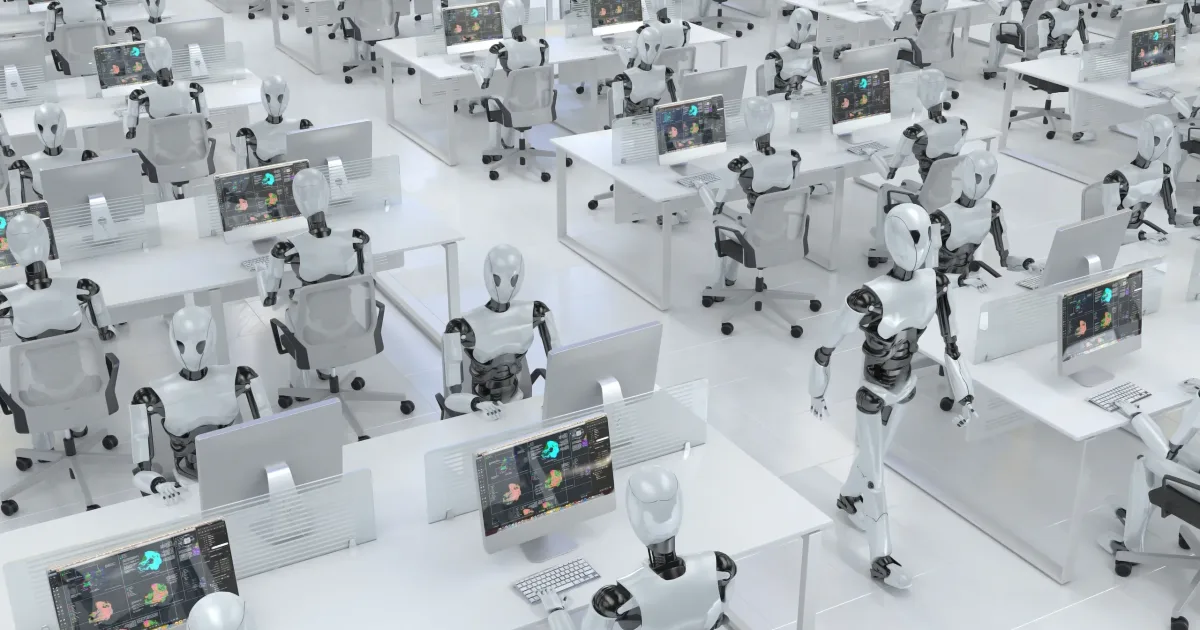
AI Is Coming for Your Job. Probably. Except When It Isn't.
Dear Reader:
Artificial intelligence has now reached that awkward stage in its development when nearly every employment story must be presented as either the dawn of a glorious new age or the end of civilization.
A CEO predicts that AI will eliminate half the jobs in some profession. A company announces layoffs and mentions AI somewhere in the press release. A new model performs a task previously thought to require a human being.
The machinery starts immediately. Headlines are written. Experts are summoned. Hands are wrung.
The disruption is real. The headline version of it often isn't.
Over the past week, we added three pieces to Current Intelligence that look at what AI is actually doing to jobs, hiring, and the people trying to get through the front door.
The Government Rated Your Job for AI Exposure
The Bureau of Labor Statistics has assigned an AI-exposure rating to 831 occupations. Each job is classified as having low, moderate, high, or very high exposure, based on how much of its work overlaps with tasks AI can perform or assist with.
That sounds suspiciously like an official list of jobs scheduled for elimination.
It isn't.
Some occupations with very high AI exposure are projected to decline sharply. Word processors and typists are expected to fall 34.4 percent by 2035. Data-entry keyers are projected to decline 25.5 percent and telemarketers 21.4 percent.
But other jobs in the same very-high-exposure category are growing rapidly. Data scientists are projected to grow 34.6 percent. Information security analysts are up 21 percent. Computer and information systems managers are expected to grow 15.8 percent.
Same exposure category. Entirely different destination.
What it means: The important question is not simply whether AI can perform parts of your job. Increasingly, it can. The better question is what happens to the occupation afterward. Does AI reduce the number of workers required, or does it make those workers more productive and increase demand for what they do?
You can read the BLS briefing and explore the interactive report.
AI Wrote the Résumé. Now AI Is Suspicious of It.
Applicants are using AI to tailor résumés and cover letters. Employers are using AI to write job descriptions and screen applications. Recruiters are experimenting with tools intended to identify AI-generated writing.
This is no longer exactly a hiring process.
It is machines arguing with machines about the authenticity of humans neither has met.
The immediate danger is not necessarily that an applicant-tracking system will flash a red warning declaring that ChatGPT wrote your résumé. The larger problem is that recruiters are receiving enormous numbers of applications that are polished, optimized, and remarkably similar.
AI can improve a résumé right up to the point where it flat-irons the humanity out of it.
No sharp edges. No distinctive voice. No sense that a particular person made the decisions and produced the results described on the page. Just another strategically minded professional who leveraged something to drive transformational outcomes.
What it means: Use AI, but do not surrender authorship of yourself. Let it compare your résumé with the job description. Let it identify weak language, missing evidence, and accomplishments you have buried. Then read what it produces and ask whether anyone who knows you would recognize the person on the page.
Leave some fingerprints.
Read "Employers Are Using AI to Screen AI-Written Résumés for Evidence of AI."
The First Rung Has Moved
The most troubling AI employment evidence concerns younger workers. Employment among people ages 22 to 25 has declined in occupations with the greatest AI exposure, with the weakness appearing more in reduced hiring than in mass layoffs.
But other evidence complicates the story. In one national survey, almost three times as many employers expected AI to increase entry-level hiring as expected it to reduce it.
The catch is that entry-level work itself is changing.
Beginners traditionally learned by doing the preliminary work: preparing drafts, assembling reports, checking spreadsheets, conducting background research, and handling routine administrative tasks. AI can now do much of that work.
Employers may continue hiring junior people, but expect them to reach the harder work sooner — to analyze information, identify problems, communicate conclusions, and exercise judgment.
The first rung of the ladder has not necessarily disappeared. It may simply be higher off the ground.
What it means: Knowing how to use AI matters. Knowing when its answer is wrong matters more. Employers continue to place a high value on critical thinking, communication, curiosity, and judgment. The strongest candidate will be the person who can use the machine without becoming dependent on it.
Our new overview, "What the AI Job Panic Is Missing," brings the latest research together and separates what is actually happening from what makes a good frightening headline.
The Bottom Line
AI will eliminate some jobs and create others. Its larger effect may be to take millions of existing jobs apart, rearrange their pieces, and put them back together differently.
That is less dramatic than saying the robots are coming for everybody's livelihood. It is also more useful.
Study what AI is doing inside your particular occupation. Learn the tools well enough that an employer does not have to start from scratch with you. Look for the responsibilities that become more valuable when routine work is automated.
And continue developing the qualities machines have not made abundant: experience, judgment, initiative, communication, and proof that you can get something done.
— Charlie
Start Here:
If you want to see how AI exposure ratings apply to your specific occupation, try the Is Your Job Exposed? BLS AI Exposure Tool. To stress-test where your job search stands right now, use the Stall Check.