
The Job Market Isn't Collapsing. Try Telling That to Someone Looking for Work.
Dear Reader:
There's a peculiar disconnect between what we're being told about the American job market and what millions of people are experiencing.
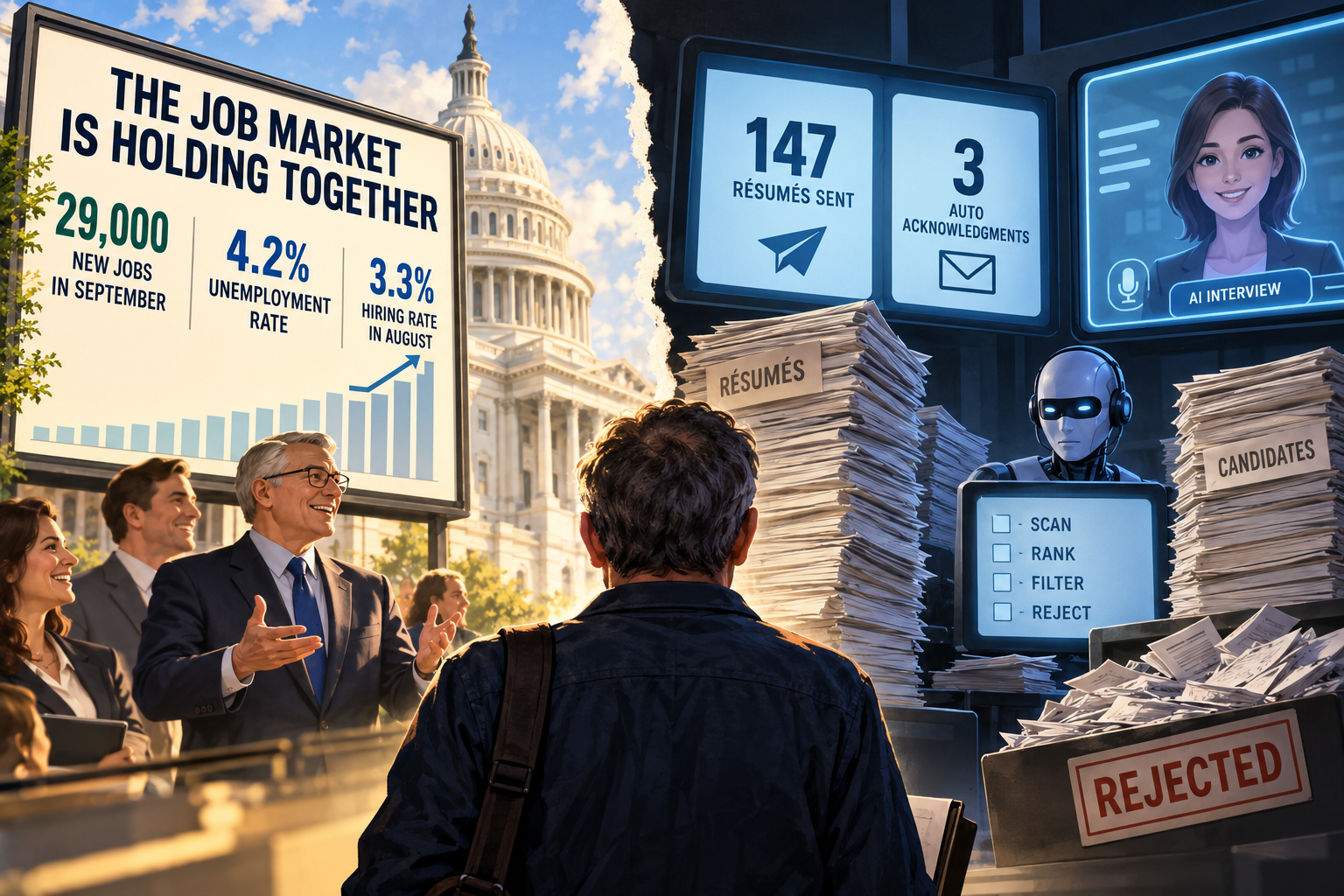
The economists tell us the labor market is holding together. The YouTube commentators tell us civilization is approaching its final employment crisis. Somewhere in between is a 52-year-old marketing executive who has sent out 147 résumés, received three automated acknowledgments, and is beginning to wonder whether anyone is actually hiring.
The numbers don't describe a collapse. September produced just 29,000 new jobs, and unemployment stood at 4.2 percent. Meanwhile, the latest available government figures put the hiring rate at 3.3 percent in August.
That last number deserves some attention. It means employers hired the equivalent of 3.3 percent of their payroll employment during the month. It doesn't mean you have a 3.3 percent chance of finding a job. But it does suggest that employers aren't exactly throwing open the doors.
And yet layoffs remain relatively subdued. This is the peculiar character of the current market. Employers are reluctant to let people go, but they're also reluctant to bring new people aboard.
If you have a reasonably secure job, things may look fairly normal. If you're outside looking in, the picture is considerably less cheerful.
We've developed a labor market that's fairly good at keeping people employed and remarkably bad at helping people become employed.
Meanwhile, the robots have arrived.
As if the situation weren't sufficiently entertaining, the hiring process itself is undergoing something of a technological nervous breakdown.
Job applicants are using AI to manufacture beautifully polished résumés. Employers are using AI to sort through them. Candidates are increasingly being interviewed by animated digital personalities that smile politely, ask questions, and occasionally behave like malfunctioning characters from a science-fiction movie.
Some of these systems are genuinely useful. They allow employers to screen candidates more quickly, provide interviews outside normal business hours, and potentially give applicants an opportunity they might never have received from an overworked recruiter.
But there's an obvious problem. When everybody can manufacture a convincing description of their qualifications, the description itself becomes less convincing.
This is why I've been emphasizing something I call proof-first hiring. Don't simply tell an employer you're a good manager. Show what happened when you managed something. Don't describe yourself as an innovative problem-solver. Explain the problem, what you did about it, and what changed.
Numbers help. Work samples help. Credible references help. A short, intelligent analysis of a prospective employer's problem may help more than another beautifully formatted résumé.
The purpose isn't to defeat the technology. It's to give the employer something the technology can't manufacture on your behalf: persuasive evidence that you can do the job.
Your assignment this week
Take one accomplishment from your career and reconstruct it. What was the problem? What were you responsible for? What did you do? What improved? Can you document the result?
Write it in 150 words or fewer.
Then take a hard look at your résumé. If that accomplishment is buried under phrases like results-oriented professional or proven track record of leadership, you've managed to hide the best evidence of your value beneath the very language everybody else is using.
Bring the evidence to the surface.
The job market isn't collapsing. But the machinery connecting qualified people with employers isn't working particularly well either. Until somebody fixes it, you'll have to do more than announce your qualifications and hope the machinery notices.
—Charlie
Get Hired in a Broken Job Market
The job market is broken. You are not.
P.S. Prompted by a series of YouTube videos protesting the use of interactive AI "avatars" to conduct screening interviews, we decided to investigate. If the feedback is so negative, why would more employers be adopting this technology? It turns out that, according to at least one study, many job seekers actually prefer AI over human interviewers — and more AI interviews result in more offers. Take a look at our article here. And, as usual, we've included links to our sources if you want to dig deeper.