
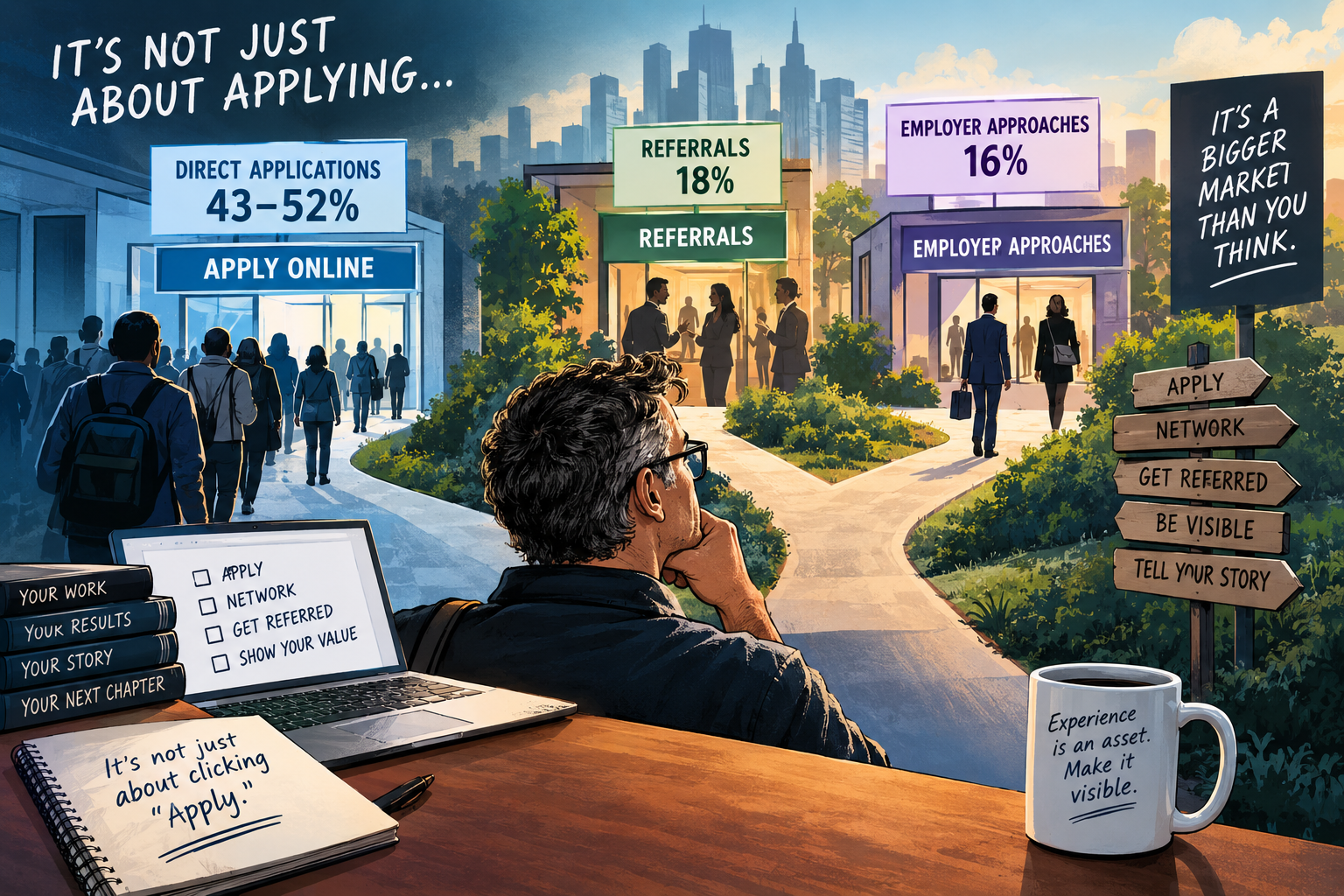
It's not just about clicking Apply.
Dear Reader,
How People Actually Get Hired
We spend a great deal of time on the mechanics of finding work. How to write the résumé. How to answer a posting. How to get through a screening system. All necessary. But sometimes the machinery takes up so much of our attention that we forget to ask a simpler question: How do people actually get hired?
They do get hired by applying. Recruiting platform Ashby examined nearly 250,000 hires and found that people who applied on their own accounted for roughly 43 to 52 percent of hires over the period studied. Online applications are alive and well, though overwhelmed. A single corporate job posting can now attract hundreds of applications. Recent employer-platform data puts the average around 200–260 applications per opening, although the number varies substantially by job, industry, and employer.
But it isn't the whole market. Referrals accounted for about 18 percent of hires in the same data, while candidates found and approached by employers accounted for about 16 percent. In a separate analysis, Ashby found that referred candidates were far more likely than ordinary applicants to reach an interview. These figures come from employers using Ashby, not every employer in America, but they remind us that the most common route isn't necessarily the only good route.
The Résumé Is Under Pressure, Too
Employers are having a harder time telling what a polished résumé proves. In a Robert Half survey, 65 percent of hiring managers said AI-enhanced résumés make candidates' skills harder to verify. Sixty-seven percent of HR leaders said reviewing AI-generated applications is slowing hiring.
I expect more employers to ask for the work behind the claims: What problem did you solve? What did you personally do? What changed? What evidence supports your account? Some may use AI to review those answers before you ever speak to a person.
That's the prediction at the heart of The Résumé Is About to Lose Its Job. The résumé will still be useful. But it may increasingly serve as a table of contents for the projects, results, and skills an employer wants to examine more closely.
Start collecting that evidence now. Keep a record of your work and its results. Save samples you're entitled to share. Stay current with how AI is changing your occupation. Keep in touch with people who can describe what it's like to work with you.
We've built a tool to help you identify accomplishments that may help you prove your abilities based on your past work. We'll warn you in advance: this tool will require some effort, but it may help. Enter reader password Crankybackroom2026! to get access to this article and the tool in the Backroom.
Job Postings Should Tell the Truth
A bill passed by both houses of the New York legislature would require covered employers and job platforms to say whether an ad is for a current vacancy and when the employer expects to fill it. If a company is only collecting résumés for possible future openings, the ad would have to say so. Employers would have to remove postings within two weeks of filling a position. The bill is not yet law.
That's an idea worth taking to every state. Find your state senator and representative and ask them to introduce a similar truth-in-job-postings bill.
Employers are free to plan ahead. Job seekers deserve to know when that's what an ad is for.
Watch my short video: Protest Ghost Jobs
Finally, if your search feels busy but doesn't get you closer to an offer, try The Audit. It takes about ten minutes to examine seven parts of your search.
The job market is broken, but you are not.
— Charles O'Neill
Get Hired in a Broken Job Market