
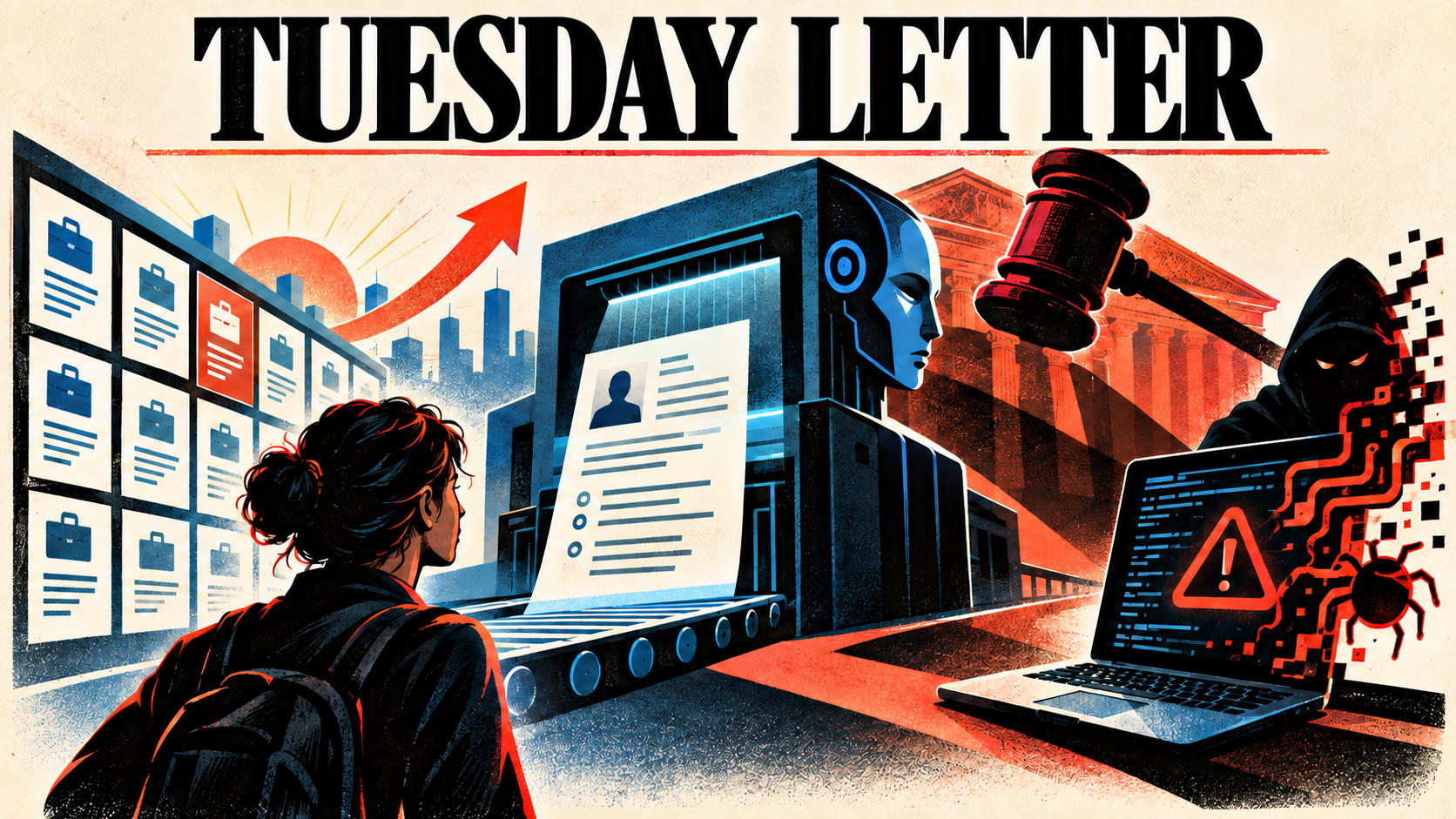
The Jobs May Be There. Can You Reach Them?
Dear Reader,
The newest forecast about artificial intelligence and American employment is not predicting mass unemployment.
In some ways, it is predicting something more complicated.
McKinsey Global Institute estimates that automation could reduce demand for the equivalent of roughly 36 million jobs by 2035, while economic growth, demographic change, infrastructure investment and new kinds of work could create demand for more than 40 million.
The arithmetic works.
The people may have a harder time.
McKinsey estimates that approximately 11 million American workers—about 7 percent of the workforce—may have to move into entirely different occupations. Under different assumptions, the number could range from six million to more than 16 million.
That is not a forecast of mass net job destruction.
It is a forecast of enormous job reshuffling.
And workers do not live on spreadsheets.
A customer-service representative cannot be subtracted from one column and inserted into healthcare, construction or project management simply because another column says a job exists.
The new position may require a credential the worker does not possess. It may be located somewhere else. It may require substantially different skills. It may demand experience that cannot be acquired without first getting hired.
McKinsey estimates that about 770,000 people may need to move between broad occupational groups every year, approximately 3.6 times the historical rate. Only about one in seven workers who need to move into growing occupations may be able to do so with little or no retraining.
More than 70 percent of workers could face meaningful changes in their skills or tasks. Demand for AI fluency has increased elevenfold since 2022, while demand for adaptability has increased fivefold. Approximately 85 percent of growing jobs in the analysis require some form of credential or certification.
The central employment problem of the next decade may not be whether America creates enough jobs.
It may be whether the people displaced from shrinking occupations can reach the work that is growing.
We published a full analysis of the McKinsey findings this week: AI May Create Enough Jobs. That Doesn't Mean You Can Get One.
Do Not Wait Until Your Occupation Starts Disappearing
Any projection reaching to 2035 should be handled carefully.
Many people reading this will have left the workforce by then. Economic forecasts are regularly rearranged by recessions, wars, pandemics, inventions and political decisions nobody anticipated when the original report was written.
The precise numbers will almost certainly be wrong.
The direction is still worth noticing.
More than 70 percent of the expected decline is concentrated in lower-paid occupational groups, including office and administrative support, retail and sales, and transportation and logistics. Meanwhile, much of the growth is expected in healthcare, construction, management and other comparatively well-paid work.
The old work and the new work may exist in the same economy without being accessible to the same people.
If you are working now, this is a reason to examine where your occupation is going before you urgently need an answer.
Look at several current job postings for the work you do—or the work you might want to do next. Which skills appear repeatedly? Which credentials are becoming standard? Which software, AI tools or technical capabilities are employers beginning to expect?
Then compare those requirements with what you can demonstrate today.
Our Side-by-Side tool helps you compare your résumé with a real job posting and see where your evidence is strong, weak or missing.
This is worth doing even if you are not looking for a job.
The least pleasant time to discover a serious skills or credential gap is three weeks after a layoff.
The national numbers may balance beautifully.
Your career still has to make the crossing.
Job Postings Are Finally Moving. Hiring Has Not Caught Up.
There is a little good news in the current market.
Indeed's Job Postings Index was 0.7 percent higher than a year earlier as of September 18. That is a very small increase, but it is the first positive year-over-year reading in almost four years.
Sixty percent of the occupational categories Indeed tracks now have more postings than they did before the pandemic, up from 51 percent at the beginning of June.
That suggests labor demand may finally be moving off the bottom.
Do not schedule the parade quite yet.
New postings—those online for seven days or less—remain approximately 6 percent below their pre-pandemic level. Hiring has also failed to keep pace with the apparent improvement in advertised openings.
In plain English: more signs are appearing in the windows, but employers are not necessarily opening the doors.
The numbers are encouraging. They are not yet a reason to abandon caution or start treating every posting as proof that a company is ready to hire.
For a closer look at the employment numbers behind the headlines, visit our Labor Market Pulse.
Who Is Responsible When an Algorithm Discriminates?
A federal lawsuit involving Workday may help determine who is responsible when an automated hiring system allegedly discriminates against applicants.
The plaintiffs claim that Workday's screening technology disproportionately rejected Black applicants, women, older workers and people with disabilities. Workday denies wrongdoing and says its software evaluates job qualifications rather than protected characteristics.
The case has not established that discrimination occurred. The plaintiffs are seeking class-action status, and a hearing is scheduled for March 2027. But the legal question is important: if an employer relies on an outside technology company to screen candidates, can the software provider be held responsible for discriminatory results—or does responsibility remain with the employer?
The answer will matter well beyond Workday.
Employers increasingly use outside systems to sort, rank and reject candidates. Applicants usually do not know which system evaluated them, what information it considered or why they disappeared from consideration.
Automation may make hiring faster.
It should not make responsibility disappear.
You can read more about AI's expanding role in screening and interviewing in AI Interviews, Résumé Tricks, and a Higher Bar for Getting Hired.
The Recruiter May Be Fake
Job seekers now have another problem to add to the list: the friendly recruiter contacting them may not exist.
Employment scams increasingly use realistic job descriptions, personalized messages, stolen corporate identities and AI-generated communications. Some scammers conduct interviews before requesting bank information, Social Security numbers or payment for equipment and background checks.
According to the Federal Trade Commission, reports of job and employment-agency scams tripled between 2020 and 2024. Reported losses rose from approximately $90 million to more than $500 million. One-third of people who reported losing money to a job or business-opportunity scam in 2025 said the contact began on social media.
Before responding to a recruiter:
- Verify the position on the employer's official career page.
- Examine the sender's complete email address.
- Contact the company through a telephone number or address you find independently.
- Never pay for equipment, training or a background check as a condition of being hired.
- Do not provide banking information or sensitive identification early in the process.
- Be suspicious of an offer made without a meaningful conversation.
Desperation is part of the scammer's business model. Urgency is not proof that an opportunity is real.
New This Week at Broken Job Market
We added several practical resources this week.
AI May Create Enough Jobs. That Doesn't Mean You Can Get One. analyzes the McKinsey Global Institute's latest workforce forecast and explains what it means for individual workers navigating the transition.
Job Postings Should Tell the Truth reviews proposed ghost-job legislation and explains what greater posting transparency could mean for job seekers.
These resources exist for the same reason the McKinsey findings matter.
The market will continue to move. Employer expectations will continue to change. Some jobs will contract. Others will grow. New barriers will appear, and occasionally somebody may even remove one.
You cannot control that machinery.
You can examine where the work is going, identify what stands between you and it, and begin closing the distance.
Do not wait for somebody to carry you across.
Find the next piece of solid ground and begin building the bridge.
—Charlie O'Neill
P.S. Think you know the facts about the dynamics of today's job market? Take our quiz to find out.
Recommended Reading
Is Your Job Exposed to AI? Use our tool to look up how the Bureau of Labor Statistics rates your occupation's exposure to artificial intelligence — and what that rating actually means for your career.
Where Do You Start with AI? A practical guide for job seekers who know AI matters but are not sure which tools are worth learning, which are hype, and where to begin.